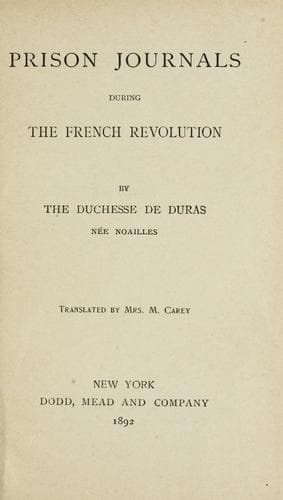
Prison Journals During the French RevolutionDuras, Louise Henriette Charlotte Philippine (de Noailles) de Durfort, duchesse de
History
Prison Journals During the French Revolution
Duras, Louise Henriette Charlotte Philippine (de Noailles) de Durfort, duchesse de
France -- History -- Revolution, 1789-1799 -- Personal narratives
The commissioner, Grandpré, fearing lest our crowded condition should
cause sickness, proposed that we should take the air in the courtyard.
We had a great aversion to going down a hundred steps, passing six
grated iron doors, preceded, accompanied, and followed by keepers. We
refused to do it for some time. Then he told us that if we paid no
regard to his request we should be charged with aristocratic opinions;
consequently, we were obliged to yield, and take the walk. The place
appointed for our promenade was very confined, enclosed by plank
fences, and surrounded by gendarmes, who kept their eyes upon us. We
found there about twenty women who had come from the Conciergerie, and
who were lodged under us without our knowing anything about it. After
conversing with them our fears were redoubled; for they gave us a most
fearful account of that terrible prison, which has been called the
anti-chamber of death. They told us that every day a large number of
victims for the scaffold were sent from there, and that our house was
considered a sort of annex to the Conciergerie. We were entirely
ignorant of what was going on outside our cells. Madame de Vassy, a
pupil of J. J. Rousseau, and daughter of Monsieur de Girardin, had
induced a jailer named Launay, the best of our keepers, to bring her
some newspapers; but this was found out, and was considered an
unpardonable crime. He was taken to another prison and put in irons,
and but for the death of Robespierre would have perished. This man, who
is still living, actually wept when he took us out on our compulsory
airing, which rather seemed like leading out a pack of dogs. Rain or
shine we were taken out for the prescribed time. If some of us wished
to go in sooner than others, we were forbidden to do so, and we were
taken out whenever our keepers chose. The men who lodged near the
stairway were obliged to retire when we passed in front of their
gratings; but their windows looked out upon the space where we were
allowed, or rather ordered, to walk, and there they often recognized
their wives and children,--all those whom they loved, and of whose very
existence they were ignorant.
Only prisoners from Chantilly were now lodged on our corridor. Among
those who came from the Conciergerie were Mesdames de Grimaldi and de
Bussy, from whom we had a full account of all the horrors which were
being enacted there. A few days later Madame de Bussy was carried off,
to be indicted by the Revolutionary tribunal; but her case was not
pressed, and she returned to Plessis. We were just congratulating her
on the subject when she was sent for again, and led to the scaffold.
She had scarcely gone when the jailers seized upon all her effects, and
tried to sell them to us,--an incident which shocked us greatly. We
repelled their disgusting proposition with horror.
Public-domain text, read in full here on John Shaqi.
Reviews
Reviews
No reviews yet
Be the first to share your thoughts on this work.
Join the Discussion
Join the discussion
Sign in to leave a comment or review.
Sign InorCreate an account