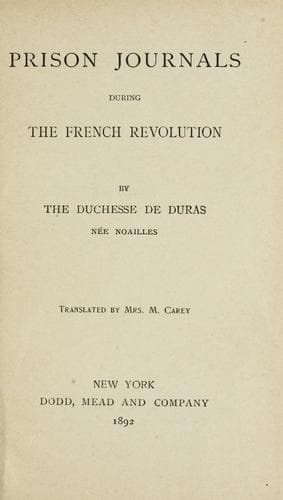
Prison Journals During the French RevolutionDuras, Louise Henriette Charlotte Philippine (de Noailles) de Durfort, duchesse de
History
Prison Journals During the French Revolution
Duras, Louise Henriette Charlotte Philippine (de Noailles) de Durfort, duchesse de
France -- History -- Revolution, 1789-1799 -- Personal narratives
I omitted to relate a very ridiculous incident. The day before the
Feast of the Supreme Being[4] all the prisoners were sent down into the
courtyard, which we found filled with an enormous quantity of branches
and leaves. I pretended to work upon them for a few minutes, and then I
withdrew into my own room; several of our wretched companions worked
away zealously, and even offered to plant a liberty-pole in the middle
of the courtyard. The keeper, less absurd than they, forbade it, saying
that such a decoration would not suit a prison. They danced in the
court; the jailers attended this strange festival,--it was the day of
Pentecost, on which Robespierre permitted God to be adored provided He
should not be called by that name. One of them praised me very much (he
was not very bad), and said that he thought I would carry myself very
well going to the guillotine; I answered him coolly that I hoped I
should. Another boasted of the rapidity with which the Revolutionary
tribunal got through with its trials; and he added that in order to set
things right, it would be necessary to cut off seven thousand heads.
One day as I was sitting alone in my room two gendarmes entered; I
thought that my last moment of life had come. They questioned me about
my father and my brothers; and as the conversation progressed, I hoped
that the mere curiosity to see a person of my rank destined for the
scaffold had attracted them. They went away, and I was much relieved by
their departure. A little while after, a female who had the appearance
of a woman of ill-fame came to tell me that she had been ordered by the
keeper to lodge in my room, and that she was going immediately to bring
in her bed. For a moment I felt extremely irritated, but I restrained
myself. I told her that I would leave the room and she could have it
all to herself. The women and young girls who were poor had entered
into a speculation which I now found useful: they took possession of
very small cells, and for money gave them up to other people, finding
some way of crowding in elsewhere. I thought of one occupied by the
daughter of the Prince of Condé's groom, and she let me have it for a
louis in _assignats_; she boasted a great deal of her kindness to me,
and indeed it was very fortunate for me. I regretted my fireplace very
much on account of its convenience for my neighbours; moreover, it was
both inconvenient and dangerous to light fires in open braziers in so
narrow a space, though under the circumstances it was absolutely
necessary. My new lodging possessed one advantage over those of Madame
de la Fayette, in that I could put a chair between my bed and the wall.
I could without rising lift the latch of my door, and even look out
into the court. My prison life taught me that even the smallest power
is precious. The difficulty of procuring light and fire enabled me to
succeed in striking a light with steel. I carefully concealed the
Public-domain text, read in full here on John Shaqi.
Reviews
Reviews
No reviews yet
Be the first to share your thoughts on this work.
Join the Discussion
Join the discussion
Sign in to leave a comment or review.
Sign InorCreate an account