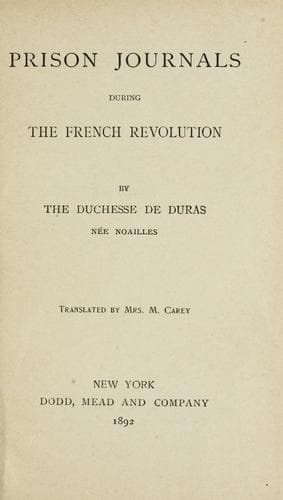
Prison Journals During the French RevolutionDuras, Louise Henriette Charlotte Philippine (de Noailles) de Durfort, duchesse de
History
Prison Journals During the French Revolution
Duras, Louise Henriette Charlotte Philippine (de Noailles) de Durfort, duchesse de
France -- History -- Revolution, 1789-1799 -- Personal narratives
The men were now allowed to walk in the courtyard with the women; I was
disgusted at this. One can easily imagine the unpleasantness of such a
mingling of hussars, spies, women and girls of the street. I advised
the good nuns not to appear. It was a horrid sight for any decent
person, still more for a holy Carmelite. I lent my chamber to these
good women that they might say their prayers in peace. One of them told
me she could not endure the language of the vulgar creatures who were
lodged with her; I told her her only resource was to stop her ears,
since she could not alter their conversation. Another went quite out of
her mind because she was not set free. One of her companions came for
me to quiet her. I went to her and undertook to treat her as though she
were ill, persuaded her to take something to drink, and comforted her
with the hope of liberty, and after a while she became calm. It was
terrible to see her.
As the number of persons who were set at liberty increased every day,
we began to hope for escape from our bars, which up to this time we had
expected to see open only for us to pass to the scaffold. The women of
the lower classes were favoured first; and six months elapsed before
any one dared say a word for one of the nobility. I felt real
gratification when I saw Monsieur Legendre, the registrar of Mouchy, go
out. Every time I had seen him, I had said to myself, 'He is one of the
victims of our family; 'and I had felt quite heart-sick on account of
it.
Our seclusion was so strict that when I met two men (the men were never
allowed to enter the building appropriated to the women) on my corridor
it astonished me greatly. They seemed curious, and asked questions. I
inquired about these new people, and was told that they were attached
to the Committee of General Security, and had considerable influence
there. One of them asked me if I belonged to the nobility; I replied
that I did. One of my companions reproved me for this, considering it
an imprudence. I told her that I never kept back the truth, and besides
it would be perfectly useless to do so. These men returned for several
days following; they showed a desire to gain the confidence of the
prisoners in order to interfere in their affairs. Those who were set at
liberty were now frequently of a higher class. Among them were priests,
soldiers, and land owners. We had very miserable recruits in their
places,--some Terrorists, and a legion of spies. The judges of the
Revolutionary tribunal came again to the clerk of our prison to inquire
for accused prisoners, who were given permission to go and confer with
their defending counsel. As for us, being only suspected, we had no
right to do so; but we pretended to have, so as to hear something from
those who were dear to us. The first person who came to see me was
Madame de la Motte; and the first who succeeded in sending me a letter
at this still most dangerous period was the Vicomtesse de Durfort. She
offered me her aid and money.
Public-domain text, read in full here on John Shaqi.
Reviews
Reviews
No reviews yet
Be the first to share your thoughts on this work.
Elsewhere in the archive
Join the Discussion
Join the discussion
Sign in to leave a comment or review.
Sign InorCreate an account