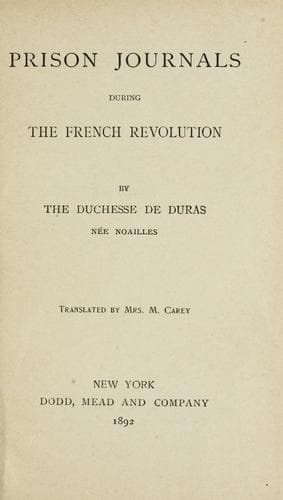
Prison Journals During the French RevolutionDuras, Louise Henriette Charlotte Philippine (de Noailles) de Durfort, duchesse de
History
Prison Journals During the French Revolution
Duras, Louise Henriette Charlotte Philippine (de Noailles) de Durfort, duchesse de
France -- History -- Revolution, 1789-1799 -- Personal narratives
The municipality of Mouchy, sent a petition to the Department of the
Oise, asking to be allowed to keep us within its limits and on its own
responsibility. It referred in kindly terms to our wise and prudent
conduct, and to our submission to the laws. The Department of the Oise,
acceded to the petition relative to my parents; but they did not
consider me old enough, and it had been said at Beauvais, that they
wished to have a titled woman at Chantilly. Consequently a sergeant of
the national gendarmes came with four horsemen to take me to Beauvais.
I was at that moment sick in bed. The village surgeon, named Marais,
and my father's physician considered that I was in no condition to be
moved; but their attestations were not sufficient, and the sergeant
sent for the physician of the Department, who decided that it was
necessary for me to remain at Mouchy, and drew up an official paper in
regard to my condition. I remained about five weeks to recuperate,
during which time several petitions were sent to the Department in my
favour. Monsieur Legendre went to see Collot d'Herbois, and Isoré. But
all these efforts were fruitless.
I was so fully persuaded that I was going to be incarcerated that I
packed up all my belongings, and hoped that my punishment would suffice
for all. It cost me great suffering to leave my honoured parents to
whom I had the comfort of being useful.
I was a little better, and had been for a few days going down into the
courtyard to take the air, when I saw a man arrive dressed in the
uniform of the National Guard,--he was the commander of the Guard at
Beauvais, and his name was Poulain. I immediately suspected with what
mission he was charged, and arranged with him that my parents should
not know of the time of my departure. We agreed that at a signal which
he would give me I should under some pretext leave the drawing-room and
not return to it. It was important that my parents should not undergo
too much emotion. I went up to them quietly and told them of my arrest.
At first they bore the announcement bravely. I avoided saying anything
to them which could agitate them, and conversed with the officer upon
ordinary subjects. He searched neither my packages nor my papers. At
last the moment came when I was obliged to leave them.
I seemed to foresee that I should never again behold my parents.
I went away, saying nothing, but feeling broken-hearted. I felt as
though my limbs were giving way under me. And that scene of grief,
which I am describing on the very spot where it took place, still
causes me deep emotion as I recall it; but there are feelings which it
is impossible to express. I have been told since, and Madame Latour
also relates it in her journal, that my father and mother remained in a
frightful state of dejection; they would take no nourishment, and
passed the nights weeping and constantly reiterating that they had been
deprived of half their existence when their dear daughter was taken
away.
Public-domain text, read in full here on John Shaqi.
Reviews
Reviews
No reviews yet
Be the first to share your thoughts on this work.
Join the Discussion
Join the discussion
Sign in to leave a comment or review.
Sign InorCreate an account