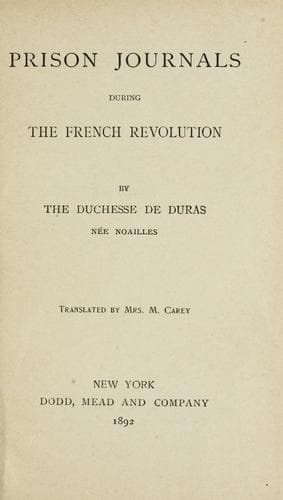
Prison Journals During the French RevolutionDuras, Louise Henriette Charlotte Philippine (de Noailles) de Durfort, duchesse de
History
Prison Journals During the French Revolution
Duras, Louise Henriette Charlotte Philippine (de Noailles) de Durfort, duchesse de
France -- History -- Revolution, 1789-1799 -- Personal narratives
On Christmas day, 1794, when the Réaumur thermometer fell to eighteen
degrees, I sat in the Rue Montorgueil, near Montmartre, through the
whole of the office, the sermon, vespers, and the benediction. I found
myself on the Pont Neuf at six o'clock in the evening, and the north
wind cut my face like a knife. I had formed the habit, after leaving
prison, of going out into the streets alone; I continued to do so, and
found it very convenient. I never took cold once during that severe
winter. I met my old acquaintances from time to time, and always felt
deeply moved. We invariably talked about the treatment in the different
prisons, and the sufferings we had endured. Almost all the prominent
persons had been imprisoned, or at least under arrest in their own
houses, which was substituted only as a great favour in the case of the
infirm or aged. We found a certain variety in the horrors; but on
comparison the Conciergerie and the Plessis proved to have been the
most terrible of all the prisons, on account of the treatment and the
great number of victims who were constantly taken from them to the
scaffold.
Madame Doudeauville very kindly persuaded me to spend a few days with
her at her country-house. Her loveliness, the attractions of her home,
the sincere sorrow she had felt at the death of my parents, and her
goodness to me, cheered me somewhat, though I was so overcome with
grief. I had almost forgotten how to write an ordinary letter, and had
long been entirely out of the habit of doing so. The carelessness of
the style of this memoir and its dullness are proof of what I have
stated.
At last I received news from my son, and this restored me to life.
The latter part of the winter was terribly hard, on account of both the
scarcity of food and the cold. It was almost impossible to procure
wood, candles, or bread. We sent thirty and forty leagues, for them. I
carried something in my pocket when I went out to dine, even at the
house of Madame la Duchesse d'Orleans, who lodged in the Rue de
Charonne, near the barrier at the Faubourg St. Antoine. She boasted of
having a farmer who sent her a loaf of bread weighing four pounds,
every week. She had wretched fare; her dishes were what are commonly
called _culs-noirs_. A dwarf served her as butler and valet. She
endured her poverty nobly, and joked about it. I remember hearing a
lady say to the queen, the wife of Louis XVI., while she was at the
Tuileries, that she knew one woman more unfortunate than she, and that
was the Duchess of Orleans. She had inherited a hundred and twenty
millions from Monsieur le Duc de Penthièvre, of which the nation took
possession, and did not even give her enough out of it to support life.
Public-domain text, read in full here on John Shaqi.
Reviews
Reviews
No reviews yet
Be the first to share your thoughts on this work.
Elsewhere in the archive
Join the Discussion
Join the discussion
Sign in to leave a comment or review.
Sign InorCreate an account