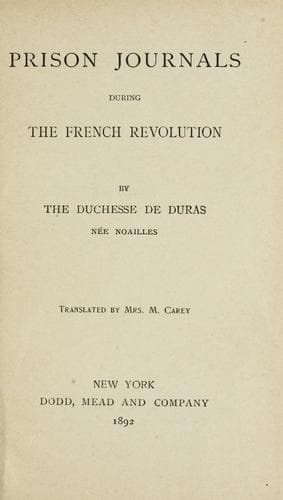
Prison Journals During the French RevolutionDuras, Louise Henriette Charlotte Philippine (de Noailles) de Durfort, duchesse de
History
Prison Journals During the French Revolution
Duras, Louise Henriette Charlotte Philippine (de Noailles) de Durfort, duchesse de
France -- History -- Revolution, 1789-1799 -- Personal narratives
The Revolution has taught us how to understand poverty, by causing us
to experience it ourselves. Two farmers on the estate of Mouchy, whose
names I record with gratitude,--Duraincy and Isoré,--sent me some
flour. I am sure a casket full of gold could never have given me so
much pleasure. People conversed in the evening only of what they had
eaten during the day. Servants stood in line from three o'clock in the
morning trying to procure provisions. Women and young girls often
waited twenty-four hours. Sometimes a whole day was spent in obtaining
a loaf of bread or two ounces of something made of hempseed, green
pears, and all sorts of horrid stuff. Whenever I had any of this
unwholesome food I divided it with those about me. It was the
_maximum_[10] that reduced Paris to this state of distress.
Soon I found myself in a fresh dilemma, being sent away from my
lodgings, which had been rented to some one else. Madame de Tourzel
offered me a residence in the name of Madame de Charost, and I accepted
it; it was very high up. I dined with my mother-in-law, and
consequently, in the evening, was exceedingly weary from the number of
steps I had climbed; for I was very much broken down from all I had
endured. The charming society of that house amply repaid me for all the
fatigue I suffered. My mother-in-law was obliged to leave the house
where she was staying, and Madame de Beuvron lent her hers. We had very
fine lodgings, but our food was miserable. My mother-in-law and I lived
for three francs a day (in _assignats_) at an eating-house,--the
uncertainty of the future compelling me to economize the small means
still left me. Both the quantity and quality of the food was
insufficient; nothing could be more disgusting than the meats which
were served us. I had long been accustomed to such fare; but I grieved
on my mother-in-law's account, though she never complained of it. She
endured the horrors of her situation with admirable resignation and
patience. Heaven doubtless sustained her to the end of her sad life. A
most fortunate thing for me now happened: Madame de Beuvron went to
occupy her own house, and several apartments became vacant in that of
Madame de la Rochefoucauld; we took possession of them on the 1st of
October, 1795. This arrangement was very much more agreeable for me; I
have continued to live there ever since, and I desire nothing better.
Being near my son and daughter-in-law adds another attraction to it;
and as my life now passes in the most commonplace fashion I end this
tiresome story, asking the reader to excuse its faults.
PARIS, February 11, 1804.
(Signed)
NOAILLES DE DURFORT-DURAS.
ADDENDA.
On re-reading my memoirs I find a great many repetitions, particularly
in the notes where I have several times referred to Madame Latour.
Public-domain text, read in full here on John Shaqi.
Reviews
Reviews
No reviews yet
Be the first to share your thoughts on this work.
Elsewhere in the archive
Join the Discussion
Join the discussion
Sign in to leave a comment or review.
Sign InorCreate an account