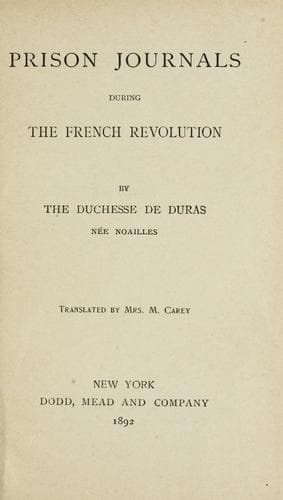
Prison Journals During the French RevolutionDuras, Louise Henriette Charlotte Philippine (de Noailles) de Durfort, duchesse de
History
Prison Journals During the French Revolution
Duras, Louise Henriette Charlotte Philippine (de Noailles) de Durfort, duchesse de
France -- History -- Revolution, 1789-1799 -- Personal narratives
How much might I say of all the many departures which preceded or
followed that of the 22d of July!--departures, peaceful or wretched,
according to the dispositions of those who departed. Terribly sad they
were, even when the known character and all external signs denoted
Christian resignation and a Christian death, but exceedingly
distressing when the contrary was the case, and when the condemned
appeared, as it were, to pass from a hell in this world to that of the
other world.
On the 22d of July, which was Tuesday, I was at my house between eight
and ten o'clock in the morning. I was just on the point of going out
when I heard a knock on my door; I opened it and saw the children of
the house of Noailles and their tutor. The children had the gayety
natural to their age,--gayety which was to be changed to sadness by the
losses they were about to undergo, and the fear of experiencing still
others. They were going to walk.
The tutor, sad and melancholy, was pale and troubled. 'Let us go into
your chamber,' said he, 'and leave the children in your study.' We went
into the chamber; he cast himself into a chair. 'It is all over, my
friend; the ladies are before the Revolutionary tribunal. I have come
to summon you to keep your word. I am to take the children to
Vincennes, and there see little Euphémie. In the park I will prepare
the poor children for their terrible loss.'
Prepared as I was myself for this dreadful blow, I was overwhelmed. The
frightful situation of the mothers, of the children, of their worthy
tutor, this gayety to be followed by such depth of sorrow, the little
sister, Euphémie, then about four years old,--all this arose before my
imagination.
I recovered myself; and after some inquiries, replies, and other sad
details, I said, 'I will now change my dress. What an errand! Pray to
God that he may give me the strength to execute it.'
We arose and went out into the study, where we found the children
amusing themselves innocently, gay and contented as could be. The sight
of them, the thought of their ignorance, and of what they were about to
learn, the interview with their sister which would follow, and that
which we had just gone through, made the contrast more striking, and
afflicted the heart.
Left alone after their departure, I felt myself overwhelmed and
wearied. 'My God,' I cried, 'have pity upon them and upon me!' I
changed my clothes and went upon certain errands, carrying in my heart
a crushing weight.
I went to the palace between one o'clock and two, and tried to enter;
it was impossible. I got some news from one who was coming out of the
Court. I still doubted the reality of what he told me. The illusion of
hope was finally destroyed by what he went on to say, and I could no
longer have any doubts.
I renewed my walk. It took me to the Faubourg St. Antoine, and with
what thoughts, what inward agitation, what secret fear, all joined to a
violent headache!
Public-domain text, read in full here on John Shaqi.
Reviews
Reviews
No reviews yet
Be the first to share your thoughts on this work.
Elsewhere in the archive
Join the Discussion
Join the discussion
Sign in to leave a comment or review.
Sign InorCreate an account