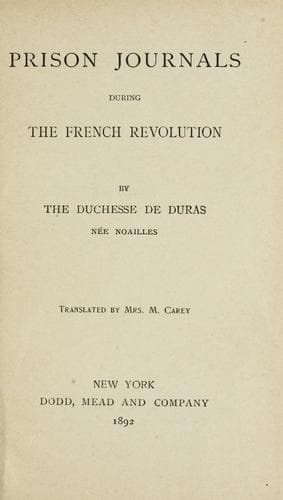
Prison Journals During the French RevolutionDuras, Louise Henriette Charlotte Philippine (de Noailles) de Durfort, duchesse de
History
Prison Journals During the French Revolution
Duras, Louise Henriette Charlotte Philippine (de Noailles) de Durfort, duchesse de
France -- History -- Revolution, 1789-1799 -- Personal narratives
I consulted a person in whom I had confidence. She encouraged me in the
name of God. I took a little coffee at her house, and felt my head
improved. I returned to the palace with slow steps, pensive and
irresolute, dreading to reach the fatal spot, and hoping that I might
not find those who summoned me there.
I arrived before five o'clock. Nothing indicated the departure of the
prisoners. I went sadly up the steps of the Sainte-Chapelle; I walked
in and around the great hall, I sat down, I rose again, I spoke to no
one. I concealed within me the sorrow which was preying upon me. From
time to time I cast a sad glance toward the courtyard, to see if any
preparations for the procession were being made.
My continual thought was, 'In two hours, in one hour, they will be no
more.' I cannot express how this idea, which has afflicted me all my
life in the too frequent and distressing occasions in which it has been
recalled, afflicted me at that time. With so dreadful a cause of
waiting, never did an hour appear to me at once so long and so short as
that which I passed from five o'clock to six, by reason of the various
thoughts which agitated me, and which rapidly drove my mind from the
illusions of a vain hope to fears unhappily only too real.
Finally, by the noise which came to my ears, I judged that the prison
doors were about to be opened. I went down and took a position near the
gate, as for a fortnight it had no longer been possible to obtain
entrance into the courtyard.
The first cart was filled and came toward where I stood. It contained
eight ladies who seemed in a very edifying frame of mind; they were
unknown to me. The ninth and last, to whom I was very near, was the
Maréchale de Noailles. The absence of her daughter-in-law and
granddaughter gave me one last faint ray of hope. But alas! they
immediately entered the second cart. Madame de Noailles was dressed in
white, which she had not ceased wearing since the death of her
father-in-law and mother-in-law, the Maréchal de Mouchy and his wife.
She appeared about twenty-four years old at the most. Madame d'Ayen, a
lady of forty years, was in a striped _déshabillé_ of blue and white. I
saw them, though at a little distance. Six men also got into the fatal
car and took their places near them. I remarked that the first two took
their stand at a little distance from the others, showing them by this
respectful attention that they desired to leave them more free. From
this I drew good auguries.
Scarcely had they taken their places when the daughter exhibited toward
the mother an eager and tender interest, which was remarked by all the
bystanders. I heard them saying near me, 'Do you see how agitated that
young lady is, and how she talks to the other one?'
I saw that they were looking for me. I seemed to hear all that they
said. 'Mamma, he is not there.'
'Look again.'
'Nothing escapes me, I assure you, Mamma; he is not there.'
Public-domain text, read in full here on John Shaqi.
Reviews
Reviews
No reviews yet
Be the first to share your thoughts on this work.
Elsewhere in the archive
Join the Discussion
Join the discussion
Sign in to leave a comment or review.
Sign InorCreate an account