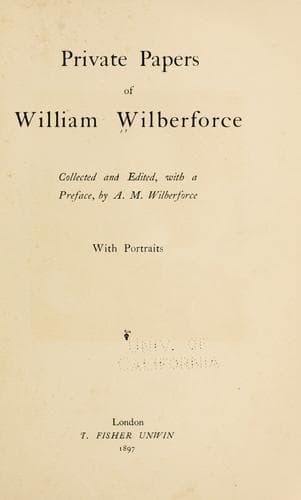
Private Papers of William WilberforceWilberforce, William
History
Private Papers of William Wilberforce
Wilberforce, William
Wilberforce, William, 1759-1833
"Although we should use great modesty in speculating on the invisible
and eternal world, yet we may reasonably presume from intimations
conveyed to us in the Holy Scriptures, and from inferences which they
fairly suggest, that we shall retain of our earthly character and
feelings in that which is not sinful, and therefore we may expect
(this, I think, is very clear), to know each other, and to think and
talk over the various circumstances of our lives, our several hopes and
fears and plans and speculations; and you and I, if it please God, may
talk over the incidents of our respective lives, and connected with
them, those of our nearest and dearest relatives. And, then, probably
we shall be enabled to understand the causes of various events which at
the time had appeared mysterious."
"_December 28, 1832._
"I should wish to suggest to you an idea that arises from a passage in
a letter from William Smith.[71] The idea is that it might have a very
good effect, for any of my reverend children to be known to manifest
their zeal in the great cause of West Indian emancipation, and slaves'
improvement. And as I am on that topic let me tell you, I need not
say with how much pleasure, that I really believe we are now going on
admirably. The slaves will, I trust, be immediately placed under the
government of the same laws as other members of the community, instead
of being under the arbitrary commands of their masters, and (perhaps
after a year) they will be still more completely emancipated. I was
truly glad to find in the evidence taken before the House of Commons'
Committee (which the indefatigable Zachary[72] is analysing), highly
honourable testimony to our friend's (Wildman's) treatment of his
slaves. But I ought not to conceal from you the connection in which W.
Smith's suggestion of the great benefit that would result from my sons
taking a forward part in befriending the attempts that would be made to
stir up a petitioning spirit in support of our cause, (for he informed
me that efforts for that purpose would be made). He stated that it had
been observed almost everywhere that the clergy had been shamefully
lukewarm in our cause; and of course this, which I fear cannot be
denied, has been used in many instances for the injury of the Church.
You and I see plainly how this has happened: that the most active
supporters of our cause have too often been democrats, and radicals,
with whom the regular clergy could not bring themselves to associate.
Yet even when subjected to such a painful alternative, to unite with
them, or to suffer the interests of justice and humanity, and latterly
of religion too, to be in question without receiving any support from
them, or to do violence to, I will not say their prejudices, but their
natural repugnance to appearing to have anything of a fellow-feeling
with men who are commonly fomenting vicious principles and propositions
of all sorts; when placed, I say, in such distressing circumstances,
Public-domain text, read in full here on John Shaqi.
Reviews
Reviews
No reviews yet
Be the first to share your thoughts on this work.
Elsewhere in the archive
Join the Discussion
Join the discussion
Sign in to leave a comment or review.
Sign InorCreate an account