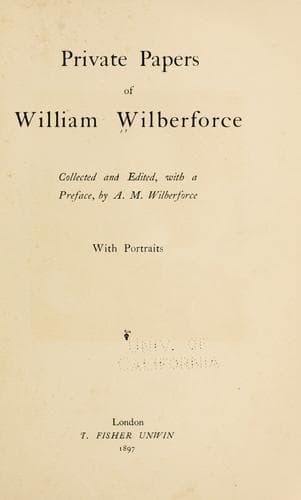
Private Papers of William WilberforceWilberforce, William
History
Private Papers of William Wilberforce
Wilberforce, William
Wilberforce, William, 1759-1833
they should remember that their coming forward, in accordance with
those with whom they agree in no other particular, will give additional
weight to their exertions, and prove still more clearly how strongly
they feel the cause of God, and the well-being of man to be implicated,
when they can consent to take part with those to whom in general
they have been opposed most strongly. The conduct of the Jamaica
people towards the missionaries has shown of late, more clearly than
ever before, that the spiritual interests of the slaves, no less
than their civil rights, are at stake. In such a case as this, it is
not without pain and almost shame that I urge any argument grounded
on the interests of the clergy; and yet it would be wrong to keep
considerations of this sort altogether out of sight, because one sees
how malignantly and injuriously to the cause of religion the apathy
of the clergy may, and will, be used, to the discredit of the Church,
and its most attached adherents. It is not a little vexatious to find
people so ignorant, as too many are, concerning the real state of the
slaves, notwithstanding all the pains that have been taken to enlighten
them. Stephen's book in particular has, I fear, been very little read.
When we were at Lord Bathurst's I saw plainly that the speeches of a
Mr. Borthwick, who had been going about giving lectures in favour of
the West Indians, had made a great impression on Lady Georgiana. But I
must lay down my pen."
FOOTNOTES:
[Footnote 1: All Pitt's letters are carefully preserved in the library
of Lavington House with the exception of this series which was found in
a disused cupboard.]
[Footnote 2: Lord Rosebery's preface to "Pitt and Wilberforce Letters,"
privately printed.]
[Footnote 3: Hon. Edward James Eliot, brother-in-law of Pitt.]
[Footnote 4: Mr. Henry Bankes, Wilberforce's life-long friend.]
[Footnote 5: "Life of Wilberforce," vol. i. p. 95.]
[Footnote 6: Afterwards first Lord Carrington.]
[Footnote 7: "Life of Wilberforce," vol. i. p. 95.]
[Footnote 8: Privately printed.]
[Footnote 9: "A Practical View of the Prevailing Religious System of
Professed Christians," &c., London, 1797.]
[Footnote 10: "Marmion," Introduction to Canto 1.]
[Footnote 11: Wimbledon.]
[Footnote 12: Hampstead.]
[Footnote 13: Here Mr. Wilberforce adds a pencilled note: "Devonshire
House Ball. King."]
[Footnote 14: Mr. Wilberforce has written over this in pencil:
"Qy.--Not a stroke of Providence could sever."]
[Footnote 15: Mr. Wilberforce has erased here "for desiring Mr. Pitt
before he went out to pass his register bills."]
[Footnote 16: Mr. Wilberforce has written here in pencil on the margin,
"Fox's Martyrs. Qy. number."]
[Footnote 17: Mr. Wilberforce adds here a pencil note in his own
handwriting: "Remarkable that when I entered York, in order to attend
a public meeting which was about to take place, there was but one
gentleman with whom I had the smallest acquaintance, the Rev. Wm.
Mason, the poet."]
Public-domain text, read in full here on John Shaqi.
Reviews
Reviews
No reviews yet
Be the first to share your thoughts on this work.
Elsewhere in the archive
Join the Discussion
Join the discussion
Sign in to leave a comment or review.
Sign InorCreate an account