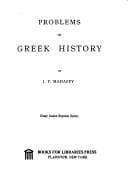
Problems in Greek historyMahaffy, J. P. (John Pentland)
History
Problems in Greek history
Mahaffy, J. P. (John Pentland)
Greece -- Historiography; Greece -- History
Hence I contend that the result of the Peloponnesian war even in its
largest crisis had little import in the world's history. That the little
raids and battles, the capture of a couple of hundred Spartans, or the
defeat of twenty ships should still be studied with minuteness, and
produce libraries of modern criticism, is due solely to the power of the
historian and the just preeminence of the famous language in which he
wrote his book.
[Sidenote: The glamour of Thucydides.]
§ 41. This is, I think, the most signal instance on record of the
falsification of the proper _perspective_ of history by individual
literary genius. It was a commonplace in old days that Achilles and
Agamemnon, Ulysses and Diomede, all the famous heroes of the Trojan war,
would have died in obscurity and passed out of sight but for the voice
of the inspired poet. How much truer is it that Phormion and Brasidas,
Gylippus and Lamachus would have virtually disappeared from history but
for the eloquence of the Attic historian! Pericles would have remained
an historic figure, and so does Lysander (who is almost beyond the
period), whether any single historian intended it or not. The rest were
important in their day and to their city, not beyond these limits. The
really great spirits from whom the Athens of that day derives her
eternal supremacy, which no Lysander could take away, are, except
Pericles, never mentioned in all his work. No one could ever suspect,
from this severe and business-like narrative, that the most splendid
architects, sculptors, and dramatic poets the world has yet seen were
then jostling each other in the streets of Athens.
[Sidenote: His calmness assumed.]
It seems thankless to complain of what Thucydides has not done, instead
of acknowledging what he undertook to do and has performed with
extraordinary ability. Never was the history of a long war written with
more power, judgment, and, I was going to say, impartiality. But I
honestly believe that his book would have been far inferior had it
indeed been coldly impartial; and I think Grote has shown, what I have
supplemented in my _Greek Literature_, that strong personal feelings
underlie the apparent calmness of his decisions[101:1].
[Sidenote: He is backed by the scholastic interest,]
§ 42. This estimate of Thucydides is, however, one which will make its
way but slowly in the English classical world,--by which I mean that
large and important body who teach classics to schoolboys and college
students,--and the schoolmaster interest so completely commands our
literary journals that any opinion which runs counter to scholastic
traditions is sure to be set down there also as the outcome of rashness
or of ignorance. For Thucydides, in addition to his just influence as a
great writer, has enlisted in his favour all those to whom Greek grammar
with its intricacies is the most divine of all pursuits.
[Sidenote: on account of his grammatical difficulties.]
Public-domain text, read in full here on John Shaqi.
Reviews
Reviews
No reviews yet
Be the first to share your thoughts on this work.
Elsewhere in the archive
Join the Discussion
Join the discussion
Sign in to leave a comment or review.
Sign InorCreate an account