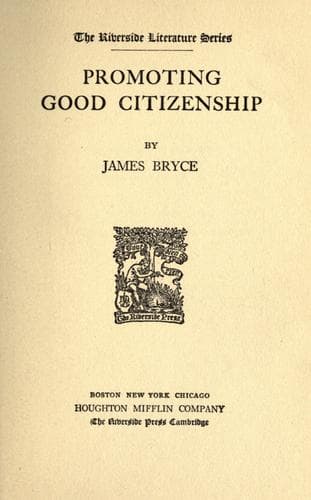
Promoting good citizenshipBryce, James Bryce, Viscount
Philosophy
Promoting good citizenship
Bryce, James Bryce, Viscount
Citizenship
If you and we, both here and in Britain, are less active than we should
be in this and other forms of civic work, the fault lies in our not
caring enough for our country. It is easy to wave a flag, to cheer
an eminent statesman, to exult in some achievement by land or sea.
But our imaginations are too dull to realize either the grandeur of
the State in its splendid opportunities for promoting the welfare of
the masses, or the fact that the nobility of the State lies in its
being the true child, the true exponent, of the enlightened will of a
right-minded and law-abiding people. Absorbed in business or pleasure,
we think too little of what our membership in a free nation means for
the happiness of our poorer fellow-citizens. The eloquent voice of a
patriotic reformer sometimes breaks our slumber. But the daily round
of business and pleasure soon again fills the mind, and public duty
fades into the background of life. This dulness of imagination and the
mere indolence which makes us neglect to stop and think, are a chief
cause of that indifference which chokes the growth of civic duty. It is
because a great University like this is the place where the imagination
of young men may best be quickened by the divine fire, because the
sons of a great University are those who may best carry with them into
after life the inspiration which history and philosophy and poetry have
kindled within its venerable walls, that I have ventured to dwell here
on the special duty which those who enjoy these privileges owe to their
brethren, partners in the citizenship of a great republic.
HOW TO OVERCOME THE OBSTACLES TO GOOD CITIZENSHIP
In the preceding three lectures[3] the chief hindrances to the
discharge of civic duty have been considered. Let us now go on to
inquire what can be done to remove these hindrances by grappling with
those faults or weaknesses in the citizen to which they are due. When
symptoms have been examined, one looks about for remedies.
[3] The two lectures reprinted in this volume are the first
and last of a series of four given by Mr. Bryce at Yale
University.
We have seen that of the three causes assigned, Indolence, Selfish
Personal Interest, and Party Spirit, the first is the most common, the
second the most noxious, the third the most excusable, yet also the
most subtle, and perhaps the most likely to affect the class which
takes the lead in politics and is incessantly employed upon its daily
work. Whether the influence of these causes, or of any of them, is
increasing with that more complete democratization of government which
we see going on in Europe, is a question that cannot yet be answered.
Fifty years may be needed before it can be answered, for new tendencies
both for good and for evil are constantly emerging and affecting one
another in unpredictable ways.
Public-domain text, read in full here on John Shaqi.
Reviews
Reviews
No reviews yet
Be the first to share your thoughts on this work.
Join the Discussion
Join the discussion
Sign in to leave a comment or review.
Sign InorCreate an account