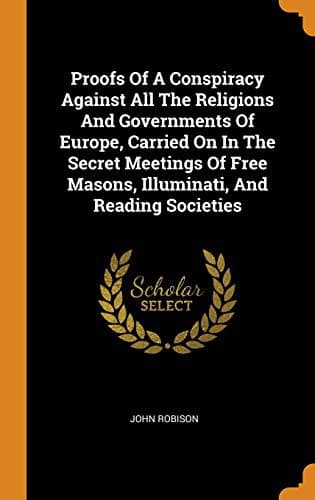
Proofs of a Conspiracy against all the Religions and Governments of Europe: carried on in the secret meetings of Free Masons, Illuminati, and reading societies. — John Shaqi
Proofs of a Conspiracy against all the Religions and Governments of Europe: carried on in the secret meetings of Free Masons, Illuminati, and reading societies.Robison, John
History
Proofs of a Conspiracy against all the Religions and Governments of Europe: carried on in the secret meetings of Free Masons, Illuminati, and reading societies.
Robison, John
Freemasonry -- Early works to 1800; Illuminati -- Early works to 1800
This shape given to the plastic mysteries of Masonry was much
relished, and in a very short time this new path was completely
explored, and a new series of degrees was added to the list,
viz. the _Novice_, and the _Elû de la Verité_, and the _Sublime
Philosophe_. In the progress through these degrees, the Brethren
must forget that they have formerly been _Chevaliers de l'Orient_,
_Chevaliers de l'Aigle_, when the symbols were all explained as
typical of the life and immortality brought to light by the gospel.
Indeed they are taught to class this among the other clouds which
have been dispelled by the sun of reason. Even in the _Chevalerie
de l'Aigle_ there is a twofold explanation given of the symbols,
by which a lively imagination may conceive the whole history and
peculiar doctrines of the New Testament, as being typical of the
final triumph of reason and philosophy over error. And perhaps this
degree is the very first step in the plan of ILLUMINATION.
We are not to suppose that this was carried to extremity at once.
But it is certain, that before 1743, it had become universal, and
that the Lodges of Free Masons had become the places for making
proselytes to every strange and obnoxious doctrine. _Theurgy_,
_Cosmogony_, _Cabala_, and many whimsical and mystical doctrines
which have been grafted on the distinguishing tenets and the pure
morality of the Jews and Christians, were subjects of frequent
discussion in the Lodges. The celebrated Chevalier Ramsay had a
great share in all this business. Affectionately attached to the
family of Stuart, and to his native country, he had co-operated
heartily with those who endeavoured to employ Masonry in the service
of the Pretender, and, availing himself of the pre-eminence given
(at first perhaps as a courtly compliment) to Scotch Masonry, he
laboured to shew that it existed, and indeed arose, during the
Crusades, and that there really was either an order of chivalry
whose business it was to rebuild the Christian churches destroyed
by the Saracens, or that a fraternity of Scotch Masons were thus
employed in the east, under the protection of the Knights of St.
John of Jerusalem. He found some facts which were thought sufficient
grounds for such an opinion, such as the building of the college
of these Knights in London, called the Temple, which was actually
done by the public Fraternity of Masons who had been in the holy
wars. It is chiefly to him that we are indebted for that rage of
Masonic chivalry which distinguishes the French Free Masonry. Ramsay
was as eminent for his piety as he was for his enthusiasm, but his
opinions were singular. His eminent learning, his elegant talents,
his amiable character, and particularly his estimation at court,
gave great influence to every thing he said on a subject which was
merely a matter of fashion and amusement. Whoever has attended much
to human affairs, knows the eagerness with which men propagate all
Public-domain text, read in full here on John Shaqi.
Reviews
Reviews
No reviews yet
Be the first to share your thoughts on this work.
Join the Discussion
Join the discussion
Sign in to leave a comment or review.
Sign InorCreate an account