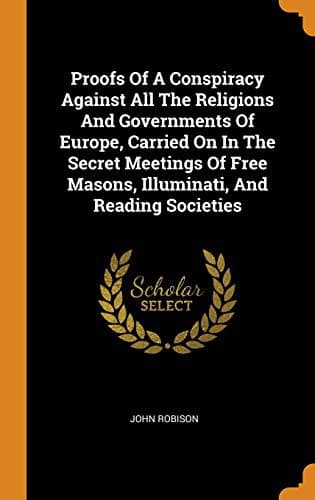
Proofs of a Conspiracy against all the Religions and Governments of Europe: carried on in the secret meetings of Free Masons, Illuminati, and reading societies.Robison, John
History
Proofs of a Conspiracy against all the Religions and Governments of Europe: carried on in the secret meetings of Free Masons, Illuminati, and reading societies.
Robison, John
Freemasonry -- Early works to 1800; Illuminati -- Early works to 1800
But it is now time to turn our eyes to the progress of Free Masonry
in Germany and the north of Europe; there it took a more serious
turn. Free Masonry was imported into Germany somewhat later than
into France. The first German Lodge that we have any account of is
that at Cologne, erected in 1716, but very soon suppressed. Before
the year 1725 there were many, both in Protestant and Catholic
Germany. Those of Wetzlar, Frankfort on the Mayne, Brunswick, and
Hamburg, are the oldest, and their priority is doubtful. All of
them received their institution from England, and had patents from
a mother Lodge in London. All seem to have got the mystery through
the same channel, the banished friends of the Stuart family. Many of
these were Catholics, and entered into the service of Austria and
the Catholic princes.
The true hospitality, that is no where more conspicuous than in the
character of the Germans, made this institution a most agreeable
and useful passport to these gentlemen; and as many of them were
in military stations, and in garrison, they found it a very easy
matter to set up Lodges in all parts of Germany. These afforded a
very agreeable pastime to the officers, who had little to occupy
them, and were already accustomed to a subordination which did not
affect their vanity on account of family distinctions. As the Ensign
and the General were equally gentlemen, the allegory or play of
universal Brotherhood was neither novel nor disgusting. Free Masonry
was then of the simplest form, consisting of the three degrees of
Apprentice, Fellow-craft, and Master. It is remarkable, that the
Germans had been long accustomed to the word, the sign, and the
gripe of the Masons, and some other handicraft trades. In many
parts of Germany there was a distinction of operative Masons into
Wort-Maurers and Schrift-Maurers. The Wort-Maurers had no other
proof to give of their having been regularly brought up to the trade
of builders, but the word and signs; the Schrift-Maurers had written
indentures to shew. There are extant and in force, borough-laws,
enjoining the Masters of Masons to give employment to journeymen
who had the proper words and sign. In particular it appears, that
some cities had more extensive privileges in this respect than
others. The word given at Wetzlar, the seat of the great council of
revision for the empire, entitled the possessor to work over the
whole empire. We may infer from the processes and decisions in some
of those municipal courts, that a master gave a word and token for
each year's progress of his apprentice. He gave the word of the
incorporated Imperial city or borough on which he depended, and
also a word peculiar to himself, by which all his own pupils could
recognise each other. This mode of recognisance was probably the
only document of education in old times, while writing was confined
to a very small part of the community. When we reflect on the nature
of the German empire, a confederation of small independent states,
Public-domain text, read in full here on John Shaqi.
Reviews
Reviews
No reviews yet
Be the first to share your thoughts on this work.
Join the Discussion
Join the discussion
Sign in to leave a comment or review.
Sign InorCreate an account