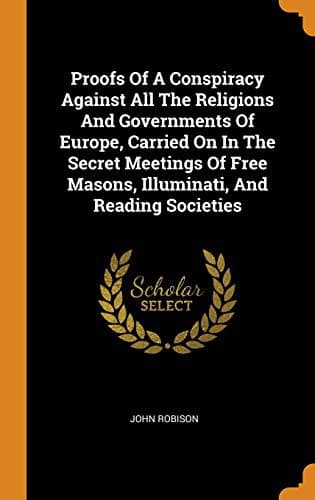
Proofs of a Conspiracy against all the Religions and Governments of Europe: carried on in the secret meetings of Free Masons, Illuminati, and reading societies. — John Shaqi
Proofs of a Conspiracy against all the Religions and Governments of Europe: carried on in the secret meetings of Free Masons, Illuminati, and reading societies.Robison, John
History
Proofs of a Conspiracy against all the Religions and Governments of Europe: carried on in the secret meetings of Free Masons, Illuminati, and reading societies.
Robison, John
Freemasonry -- Early works to 1800; Illuminati -- Early works to 1800
About this very time there was a great revolution of the public
mind in Germany, and scepticism, infidelity, and irreligion, not
only were prevalent in the minds and manners of the wealthy and
luxurious, and of the profligate of lower ranks, but began to appear
in the productions of the press. Some circumstances, peculiar to
Germany, occasioned these declensions from the former acquiescence
in the faith of their forefathers to become more uniform and
remarkable than they would otherwise have been. The confessions
of Germany are the Roman Catholic, the Lutheran, (which they
call Protestant,) and the Calvinist, (which they call Reformed).
These are professed in many small contiguous principalities, and
there is hardly one of them in which all the three have not free
exercise. The desire of making proselytes is natural to all serious
professors of a rational faith, and was frequently exercised. The
Roman Catholics are supposed by us to be particularly zealous, and
the Protestants (Lutherans and Calvinists) were careful to oppose
them by every kind of argument, among which those of ridicule and
reproach were not spared. The Catholics accused them of infidelity
respecting the fundamental doctrines of Christianity which they
professed to believe, and even with respect to the doctrines of
natural religion. This accusation was long very slightly supported;
but, of late, by better proofs. The spirit of free enquiry was
the great boast of the Protestants, and the only support against
the Catholics, securing them both in their religious and civil
rights. It was therefore encouraged by their governments. It
is not to be wondered at that it should be indulged to excess,
or improperly, even by serious men, liable to error, in their
disputes with the Catholics. In the progress of this contest,
even their own Confessions did not escape criticism, and it was
asserted that the Reformation which those Confessions express was
not complete. Further Reformations were proposed. The Scriptures,
the foundation of our faith, were examined by clergymen of very
different capacities, dispositions, and views, till by explaining,
correcting, allegorising, and otherwise twisting the Bible, men's
minds had hardly any thing left to rest on as a doctrine of revealed
religion. This encouraged others to go farther, and to say that
revelation was a solecism, as plainly appeared by the irreconcilable
differences among those Enlighteners (so they were called) of the
public, and that man had nothing to trust to but the dictates of
natural reason. Another set of writers, proceeding from this as a
point already settled, proscribed all religion whatever, and openly
taught the doctrines of materialism and atheism. Most of these
innovations were the work of Protestant divines, from the causes
that I have mentioned. Teller, Semler, Eberhardt, Lessing, Bahrdt,
Riem, and Shultz, had the chief hand in all these innovations.
But no man contributed more than Nicholai, an eminent and learned
Public-domain text, read in full here on John Shaqi.
Reviews
Reviews
No reviews yet
Be the first to share your thoughts on this work.
Join the Discussion
Join the discussion
Sign in to leave a comment or review.
Sign InorCreate an account