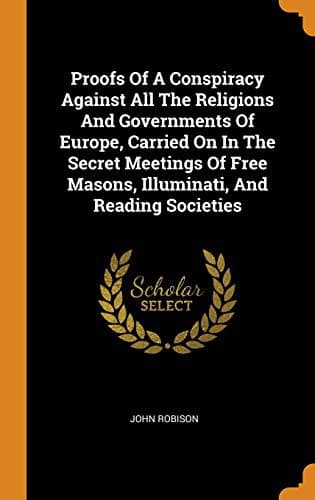
Proofs of a Conspiracy against all the Religions and Governments of Europe: carried on in the secret meetings of Free Masons, Illuminati, and reading societies.Robison, John
History
Proofs of a Conspiracy against all the Religions and Governments of Europe: carried on in the secret meetings of Free Masons, Illuminati, and reading societies.
Robison, John
Freemasonry -- Early works to 1800; Illuminati -- Early works to 1800
Although every Principality has an officer for licensing, it is
impossible to prevent the currency of a performance, although it
may be prohibited; for it is to be had by the carrier at three or
four miles distance in another state. By this mode of traffic,
a plot may be formed, and actually has been formed, for giving
any particular turn to the literature of the country. There is
an excellent work printed at Bern by the author Heinzmann, a
bookseller, called, _Appeal to my Country, concerning a Combination
of Writers, and Booksellers, to rule the Literature of Germany, and
form the Public Mind into a Contempt for the Religion and Civil
Establishments of the Empire_. It contains a historical account of
the publications in every branch of literature for about thirty
years. The author shows, in the most convincing manner, that the
prodigious change from the former satisfaction of the Germans on
those subjects to their present discontent and attacks from every
quarter, is neither a fair picture of the prevailing sentiments,
nor has been the simple operation of things, but the result of a
combination of trading Infidels.
I have here somewhat anticipated, (for I hope to point out the
sources of this combination,) because it helps to explain or
illustrate the progress of infidelity and irreligion that I was
speaking of. It was much accelerated by another circumstance.
One _Basedow_, a man of talents and learning, set up, in the
Principality of Anhalt-Dessau, a PHILANTHROPINE, or academy of
general education, on a plan extremely different from those of the
Universities and Academies. By this appellation, the founder hoped
to make parents expect that much attention would be paid to the
morals of the pupils; and indeed the programs or advertisements by
which Basedow announced his institution to the public, described
it as the professed seminary of practical Ethics. Languages,
sciences, and the ornamental exercises, were here considered as mere
accessories, and the great aim was to form the young mind to the
love of mankind and of virtue, by a plan of moral education which
was very specious and unexceptionable. But there was a circumstance
which greatly obstructed the wide prospects of the founder. How were
the religious opinions of the youth to be cared for? Catholics,
Lutherans, and Calvinists, were almost equally numerous in the
adjoining Principalities; and the exclusion of any two of these
communions would prodigiously limit the proposed usefulness of
the institution. Basedow was a man of talents, a good scholar,
and a persuasive writer. He framed a set of rules, by which the
education should be conducted, and which, he thought, should make
every parent easy; and the plan is very judicious and manly. But
none came but Lutherans. His zeal and interest in the thing made
him endeavour to interest others; and he found this no hard matter.
The people of condition, and all sensible men, saw that it would be
Public-domain text, read in full here on John Shaqi.
Reviews
Reviews
No reviews yet
Be the first to share your thoughts on this work.
Join the Discussion
Join the discussion
Sign in to leave a comment or review.
Sign InorCreate an account