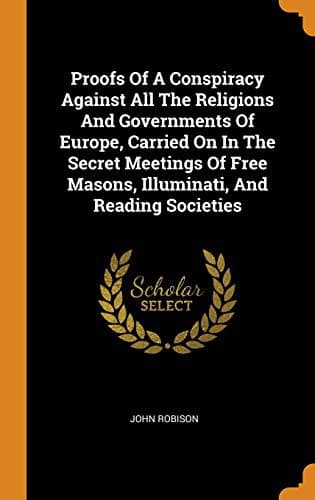
Proofs of a Conspiracy against all the Religions and Governments of Europe: carried on in the secret meetings of Free Masons, Illuminati, and reading societies.Robison, John
History
Proofs of a Conspiracy against all the Religions and Governments of Europe: carried on in the secret meetings of Free Masons, Illuminati, and reading societies.
Robison, John
Freemasonry -- Early works to 1800; Illuminati -- Early works to 1800
It were well had this been all. But most unfortunately, though
most naturally, writers of loose moral principles and of wicked
hearts were encouraged by the impunity which the sceptical writers
experienced, and ventured to publish things of the vilest tendency,
inflaming the passions and justifying licentious manners. These
maxims are congenial with irreligion and Atheism, and the books
found a quick market. It was chiefly in the Prussian States
that this went on. The late King was, to say the best of him, a
naturalist, and, holding this life for his all, gave full liberty
to his subjects to write what they pleased, provided they did not
touch on state matters. He declared, however, to a minister of his
court, long before his death, that "he was extremely sorry that his
indifference had produced such effects; that he was sensible it had
greatly contributed to hurt the peace and mutual good treatment
of his subjects;" and he said, "that he would willingly give up
the glory of his best-fought battle, to have the satisfaction of
leaving his people in the same state of peace and satisfaction
with their religious establishments, that he found them in at his
accession to the throne." His successor Frederick William found
that things had gone much too far, and determined to support the
church-establishment in the most peremptory manner; but at the
same time to allow perfect freedom of thinking and conversing to
the professors of every Christian faith, provided it was enjoyed
without disturbing the general peace, or any encroachment on the
rights of those already supported by law. He published an edict
to this effect, which is really a model worthy of imitation in
every country. This was the epoch of a strange revolution. It
was attacked from all hands, and criticisms, satires, slanders,
threatenings, poured in from every quarter. The independency of the
neighbouring states, and the monarch's not being a great favourite
among several of his neighbours, permitted the publication of those
pieces in the adjoining principalities, and it was impossible to
prevent their circulation even in the Prussian States. His edict was
called an unjustifiable tyranny over the consciences of men; the
dogmas supported by it were termed absurd superstitions; the King's
private character, and his opinions in religious matters, were
treated with little reverence, nay, were ridiculed and scandalously
abused. This field of discussion being thus thrown open, the writers
did not confine themselves to religious matters. After flatly
denying that the prince of any country had the smallest right to
prescribe, or even direct the faith of his subjects, they extended
their discussions to the rights of princes in general; and now
they fairly opened their trenches, and made an attack in form on
the constitutions of the German confederacy, and, after the usual
approaches, they set up the standard of universal citizenship on
Public-domain text, read in full here on John Shaqi.
Reviews
Reviews
No reviews yet
Be the first to share your thoughts on this work.
Join the Discussion
Join the discussion
Sign in to leave a comment or review.
Sign InorCreate an account