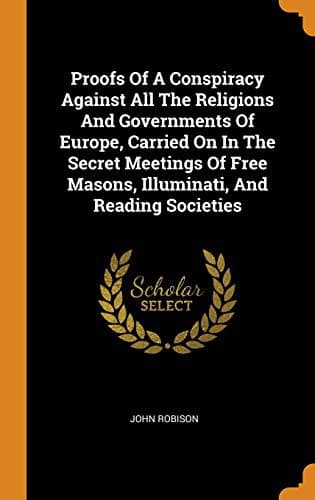
Proofs of a Conspiracy against all the Religions and Governments of Europe: carried on in the secret meetings of Free Masons, Illuminati, and reading societies.Robison, John
History
Proofs of a Conspiracy against all the Religions and Governments of Europe: carried on in the secret meetings of Free Masons, Illuminati, and reading societies.
Robison, John
Freemasonry -- Early works to 1800; Illuminati -- Early works to 1800
This short account of the _Noviciate_, and of the lowest class of
illuminati, is all we can get from the authority of Mr. Weishaupt.
The higher degrees were not published by him. Many circumstances
appear suspicious, are certainly susceptible of different turns,
and may easily be pushed to very dangerous extremes. The accounts
given by the four professors confirm these suspicions. They declare
upon oath, that they make all these accusations in consequence of
what they heard in the meetings, and of what they knew of the Higher
Orders.
But since the time of the suppression by the Elector, discoveries
have been made which throw great light on the subject. A collection
of original papers and correspondence was found by searching the
house of one Zwack (a Member) in 1786. The following year a much
larger collection was found at the house of Baron Bassus; and since
that time Baron Knigge, the most active Member next to Weishaupt,
published an account of some of the higher degrees, which had been
formed by himself. A long while after this were published, _Neueste
Arbeitung des Spartacus und Philo in der Illuminaten Orden_, and
_Hohere Graden des Illum. Ordens_. These two works give an account
of the whole secret constitution of the Order, its various degrees,
the manner of conferring them, the instructions to the intrants, and
an explanation of the connection of the Order with Free Masonry, and
a critical history. We shall give some extracts from such of these
as have been published.
Weishaupt was the founder in 1776. In 1778 the number of Members
was considerably increased, and the Order was fully established.
The Members took antique names. Thus Weishaupt took the name of
Spartacus, the man who headed the insurrection of slaves, which in
Pompey's time kept Rome in terror and uproar for three years. Zwack
was called Cato. Knigge was Philo. Bassus was Hannibal. Hertel
was Marius. Marquis Constanza was Diomedes.--Nicolai, an eminent
and learned bookseller in Berlin, and author of several works of
reputation, took the name of Lucian, the great scoffer at all
religion. Another was Mahomet, &c. It is remarkable, that except
Cato and Socrates, we have not a name of any ancient who was eminent
as a teacher and practiser of virtue. On the contrary, they seem
to have affected the characters of the free-thinkers and turbulent
spirits of antiquity. In the same manner they gave ancient names to
the cities and countries of Europe. Munich was Athens, Vienna was
Rome, &c.
_Spartacus to Cato, Feb. 6, 1778._
Public-domain text, read in full here on John Shaqi.
Reviews
Reviews
No reviews yet
Be the first to share your thoughts on this work.
Elsewhere in the archive
Join the Discussion
Join the discussion
Sign in to leave a comment or review.
Sign InorCreate an account