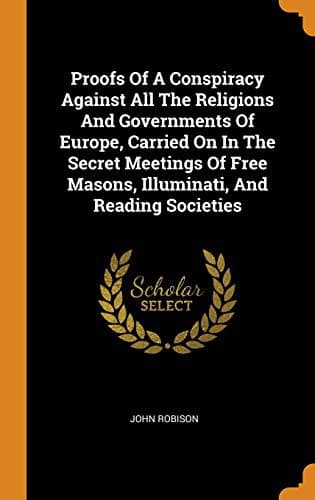
Proofs of a Conspiracy against all the Religions and Governments of Europe: carried on in the secret meetings of Free Masons, Illuminati, and reading societies.Robison, John
History
Proofs of a Conspiracy against all the Religions and Governments of Europe: carried on in the secret meetings of Free Masons, Illuminati, and reading societies.
Robison, John
Freemasonry -- Early works to 1800; Illuminati -- Early works to 1800
"We must, _1st_, gradually explain away all our preparatory pious
frauds. And when persons of discernment find fault, we must desire
them to consider the end of all our labour. This sanctifies our
means, which at any rate are harmless, and have been useful, even
in this case, because they procured us a patient hearing, when
otherwise men would have turned away from us like petted children.
This will convince them of our sentiments in all the intervening
points; and our ambiguous expressions will then be interpreted into
an endeavour to draw answers of any kind, which may show us the
minds of our pupils. _2d_, We must unfold, from history and other
writings, the origin and fabrication of all religious lies whatever;
and then, _3d_, We give a critical history of the Order. But I
cannot but laugh, when I think of the ready reception which all this
has met with from the grave and learned divines of Germany and of
England; and I wonder how their William failed when he attempted
to establish a Deistical Worship in London, (what can this mean?)
for, I am certain, that it must have been most acceptable to that
learned and free people. But they had not the enlightening of our
days." I may here remark, that Weishaupt is presuming too much on
the ignorance of his friend, for there was a great deal of this
enlightening in England at the time he speaks of, and if I am not
mistaken, even this celebrated Professor of Irreligion has borrowed
most of his scheme from this kingdom. This to be sure is nothing in
our praise. But the PANTHEISTICON of Toland resembles Weishaupt's
Illumination in every thing but its rebellion and its villainy.
Toland's Socratic Lodge is an elegant pattern for Weishaupt, and
his Triumph of Reason, his Philosophic Happiness, his God, or
_Anima Mundi_, are all so like the harsh system of Spartacus, that
I am convinced that he has copied them, stamping them with the
roughness of his own character. But to go on; Spartacus says of the
English: "Their poet Pope made his Essay on Man a system of pure
naturalism, without knowing it, as Brother Chrysippus did with my
Priest's Degree, and was equally astonished when this was pointed
out to him. Chrysippus is religious, but not superstitious. Brother
Lucian (Nicolai, of whom I have already said so much) says, that the
grave Zolikofer now allows that it would be a very proper thing to
establish a Deistical Worship at Berlin. I am not afraid but things
will go on very well. But Philo, who was entrusted with framing the
Priest's Degree, has destroyed it without any necessity; it would,
forsooth, startle those who have a hankering for Religion. But I
always told you that Philo is fanatical and prudish. I gave him fine
materials, and he has stuffed it full of ceremonies and child's
play, and as Minos says, _c'est jouer la religion_. But all this may
be corrected in the revision by the _Areopagitæ_."
Public-domain text, read in full here on John Shaqi.
Reviews
Reviews
No reviews yet
Be the first to share your thoughts on this work.
Elsewhere in the archive
Join the Discussion
Join the discussion
Sign in to leave a comment or review.
Sign InorCreate an account