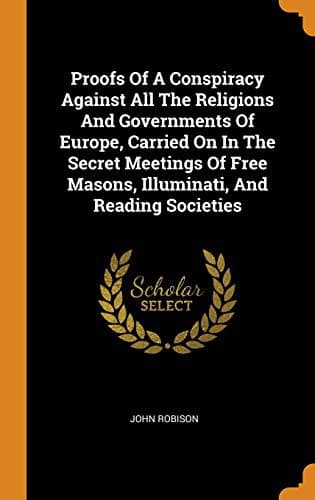
Proofs of a Conspiracy against all the Religions and Governments of Europe: carried on in the secret meetings of Free Masons, Illuminati, and reading societies.Robison, John
History
Proofs of a Conspiracy against all the Religions and Governments of Europe: carried on in the secret meetings of Free Masons, Illuminati, and reading societies.
Robison, John
Freemasonry -- Early works to 1800; Illuminati -- Early works to 1800
N. B. I have already mentioned Baron Knigge's conversion to
Illuminatism by the M. de Constanza, whose name in the Order was
Diomedes. Knigge (henceforth Philo) was, next to Spartacus, the most
serviceable man in the Order, and procured the greatest number of
members. It was chiefly by his exertions among the Masons in the
Protestant countries, that the _Eclectic System_ was introduced,
and afterwards brought under the direction of the Illuminati. This
conquest was owing entirely to his very extensive connections
among the Masons. He travelled like a philosopher from city to
city, from Lodge to Lodge, and even from house to house, before
his Illumination, trying to unite the Masons, and he now went over
the same ground to extend the _Eclectic System_, and to get the
Lodges put under the direction of the Illuminati, by their choice
of the Master and Wardens. By this the Order had an opportunity of
noticing the conduct of individuals; and when they had found out
their manner of thinking, and that they were fit for their purpose,
they never quitted them till they had gained them over to their
party. We have seen, that he was by no means void of religious
impressions, and we often find him offended with the atheism of
Spartacus. Knigge was at the same time a man of the world, and had
kept good company. Weishaupt had passed his life in the habits of a
college: therefore he knew Knigge's value, and communicated to him
all his projects, to be dressed up by him for the taste of society.
Philo was of a much more affectionate disposition, with something
of a devotional turn, and was shocked at the hard indifference
of Spartacus. After labouring four years with great zeal, he was
provoked with the disingenuous tricks of Spartacus, and he broke
off all connection with the Society in 1784, and some time after
published a declaration of all that he had done in it. This is a
most excellent account of the plan and principles of the Order, (at
least as he conceived it, for Spartacus had much deeper views,) and
shows that the aim of it was to abolish Christianity, and all the
state-governments in Europe, and to establish a great republic. But
it is full of romantic notions and enthusiastic declamation, on the
hackneyed topics of universal citizenship, and liberty and equality.
Spartacus gave him line, and allowed him to work on, knowing that
he could discard him when he chose. I shall after this give some
extracts from Philo's letters, from which the reader will see the
vile behaviour of Spartacus, and the nature of his ultimate views.
In the mean time we may proceed with the account of the principles
of the system.
_Spartacus to Cato._
Public-domain text, read in full here on John Shaqi.
Reviews
Reviews
No reviews yet
Be the first to share your thoughts on this work.
Elsewhere in the archive
Join the Discussion
Join the discussion
Sign in to leave a comment or review.
Sign InorCreate an account