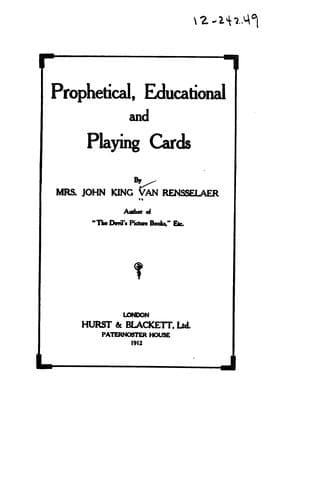
Prophetical, Educational and Playing CardsVan Rensselaer, John King, Mrs.
Religion
Prophetical, Educational and Playing Cards
Van Rensselaer, John King, Mrs.
Fortune-telling by cards -- History; Playing cards -- History
The Spaniards call the Two spot Dos, the Germans name it Daus, and the
French and English dub it Deuce. Although it is always the lowest in the
pack, since in almost all games the Aces are "high," there is an old
proverb which says, "There's luck under the black Deuce," and old whist
players had a habit of trying to prevent the good fortune from falling to
an adversary when they turned it up for trumps by saying, "Not when the
right elbow is on it," and suiting the action to the word.
In England, at one time, the Nine of Diamonds was called "the curse of
Scotland," or "the cross of Scotland," referring to the arrangement of the
pips, which, with the addition of a few connecting lines, can be made to
look like the heraldic St. Andrew's cross on the arms of Scotland. Mr.
Taylor quotes on page 235 from "The Oracle or Resolver of Questions"
(1770), saying "the Crown of Scotland had but nine diamonds in it, so that
was the origin of the name for that card."
An explanation is given for calling the card "a curse," as there is a
tradition that it was on this card that "the Butcher Duke of Cumberland"
wrote his sanguinary order after the battle of Culloden, and yet another
reason given is that, in the game called after her, the Nine of Diamonds
is named Pope Joan, to whom a large forfeit must be paid. Old Chinese
laquered boxes, that also contained beautifully carved mother-of-pearl
counters (chips), always had several little trays in them, which obviated
the necessity for spoiling a fresh pack of cards and folding them for the
necessary trays. The Chinese boxes had the Kings, Queens, Knaves, and
Nines of Diamonds painted on their bottom. These were placed in the centre
of the table and the forfeited counters paid into them. The game called
for one chip to be paid to the King, two to the Queen, three to the Knave,
and four to Pope Joan (the Nine of Diamonds), causing this card to be
disliked by players, who considered it "a curse."
We call the Three spot a Trey, which name is probably derived from the
Spanish Tres or the French Trois.
The Four of Hearts is sometimes called Bob Collingwood, and is by some
considered an unlucky card, while the Four of Spades has received the name
of Ned Stokes; but these are probably localisms and have but little
interest for the general public. The Four of Clubs is nicknamed "the
Devil's bed-posts," and in the old game of Gleek all the Fours were named
Tiddy. The Four of Money frequently bears the emblem of the double star,
signifying the "house of David," that was one of the signs adopted by
Freemasons.
In the game of Gleek the Fives were called Towser, and the Sixes Tumbler,
and these were lucky cards, as they counted double when they were turned
up as Trumps.
Public-domain text, read in full here on John Shaqi.
Reviews
Reviews
No reviews yet
Be the first to share your thoughts on this work.
Elsewhere in the archive
Join the Discussion
Join the discussion
Sign in to leave a comment or review.
Sign InorCreate an account