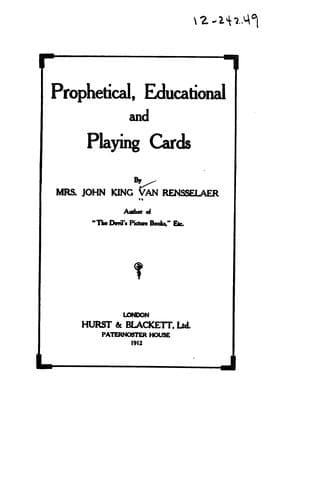
Prophetical, Educational and Playing CardsVan Rensselaer, John King, Mrs.
Religion
Prophetical, Educational and Playing Cards
Van Rensselaer, John King, Mrs.
Fortune-telling by cards -- History; Playing cards -- History
"In Ireland," says Mr. Taylor, "the Six of Hearts is called 'Grace's
card,' from the spirited answer returned by one of that family to Marshal
Schomberg, who sent to tempt Grace to espouse the cause of William of
Orange. A reply was written on the Six of Hearts as follows: 'Tell your
master that I despise his offer, and that honour and conscience are dearer
to me than all the wealth and titles that a prince can bestow.'"
Lady Dorothy Nevill, in her interesting book, "Under Five Reigns," says
(page 320): "Visiting cards, it is not generally known, originated from
ordinary playing cards, which were used as such as late as the end of the
eighteenth century. A proof of this is that when, some time ago, certain
repairs were being made at a house in Dean Street, Soho, a few playing
cards were found with names written on their backs behind a marble chimney
piece. One of the cards in question was inscribed Isaac Newton, and the
house had been the residence of his father-in-law, Hogarth, in one of
whose pictures of Marriage a la Mode, Plate IV, several 'playing card'
visiting cards may be seen lying on the floor on the right side of the
picture. On one of them is inscribed, 'Count Basset begs to no how Lady
Squander slept last nite.' As time went on, specially devised visiting
cards with somewhat ornate calligraphy took the place of playing cards,
and these, in time, developed into the small and simple pieces of
pasteboard in use to-day."
Although the Tarots and the cards of many nations have well-decorated
engraved backs, these sometimes were simply chequered or covered with tiny
dots, which made some writers believe the name Tarot to be derived from
_taroté_, or spotted; but this was not the case, since the original name
for cards was the "Book of Thoth."
CHAPTER XII
"ACCORDING TO HOYLE"
The ancestor of all our common games of cards is probably L'Ombre, El
Hombre, or The Man, sometimes also called La Beste, the origin of which
has been traced to the middle of the fourteenth century in Italy, where
the original Tarots were used as they are to-day. A modification of the
old game is called Tarroco, the rules for which have been altered during
the centuries that have passed since the game was first taken to the
hearts of the gamblers, who succeeded the fortune-tellers or the priests
of Mercury. The game having now but few interpreters, the cards have
nearly ceased to bear the messages of the gods, and the cult of Mercury is
forgotten.
L'Ombre was played during the fourteenth century in Spain, and wandered to
England, France, Germany, and Austria. It still receives its original
title in the first two countries, and is played by country folk, but in
France it seems to have been discarded.
Public-domain text, read in full here on John Shaqi.
Reviews
Reviews
No reviews yet
Be the first to share your thoughts on this work.
Elsewhere in the archive
Join the Discussion
Join the discussion
Sign in to leave a comment or review.
Sign InorCreate an account