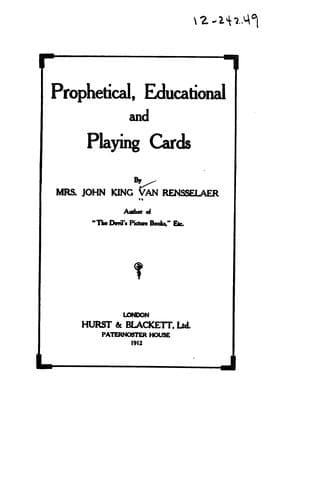
Prophetical, Educational and Playing CardsVan Rensselaer, John King, Mrs.
Religion
Prophetical, Educational and Playing Cards
Van Rensselaer, John King, Mrs.
Fortune-telling by cards -- History; Playing cards -- History
It is supposed that the first reference to Piquet in print is in the works
of Rabelais, already quoted from (1533). Probably the earliest book of
rules is the one published at Rome in 1647, and translated into English in
1652. The rules were very much the same as those laid down afterwards by
Cavendish in 1882. The "point" was called the "ruffe," or, in French,
Ronflé.
In "Les Facheux," by Molière (1661), there is an interesting Piquet hand
described by Alcippe, one of the players. In 1646 a _Ballet du Jeu de
Piquet_ was produced, in which the dancers were ranged according to their
colours, the blacks opposite to the reds and both sides headed by the
court cards. This ballet became a great favourite and was often produced,
as it interested the audiences, who appreciated the various movements of
the dance that reproduced and corresponded with the play of the game.
English and French plays frequently refer to the card games of their day,
and Piquet is often mentioned. In the Epilogue to "Sir Harry Wildair"
(1701) is the following:
Vat have you got of grand plasir in dis town?
'Tis said Vidont is come from France, dat vil go down.
Piquet, Basset, your vin, your dress, your dance,
'Tis all you see tout a la mode de France.
John Hall was one of the early writers in England who referred to
Piquet, originally called Cent in that country. He says, in 1646, "a man's
fancy (or character) would be summed up at Cribbage; Gleek requires a
vigilant memory, Mawe a pregnant agility, Picket a various invention,
Primero a dexterous kind of rashness."
[Illustration: EARLY ITALIAN TAROTS
Pip Cards of the Money Suit
67 Ace of Money
68 Deuce of Money
69 Trey of Money
70 Four of Money
71 Five of Money
72 Six of Money]
In 1659 a curious pamphlet was published called "Shuffling, Cutting, and
Dealing in a Game at Pickquet," a political squib which used the terms of
the game to describe the politicians.
Hamlet says: "How absolute the Knave is. We must speak by the card or
equivocation will undo us. By the Lord, Horatio, these three years I have
taken notice of it, the age is grown so picked (piqued)."
As the French cards, with the game of Piquet for which they were invented,
were introduced into England in the time of Edward IV, it is possible that
Hamlet used a familiar term when he declared the age was picked, as this
is an expression frequently used in the game.
It is generally supposed that Euchre is a variant of the French game
Ecarté, the name of which is taken from one of the rules, meaning "to put
away or discard." In the United States, Euchre was adopted about 1840,
appearing first in the Middle West. It was for this game that the Joker
was reinstated in the pack, a card that at first was a blank one left
imprinted, but its adoption was accomplished very slowly, and it did not
change the games or completely dominate the packs until within the last
few years.
Public-domain text, read in full here on John Shaqi.
Reviews
Reviews
No reviews yet
Be the first to share your thoughts on this work.
Elsewhere in the archive
Join the Discussion
Join the discussion
Sign in to leave a comment or review.
Sign InorCreate an account