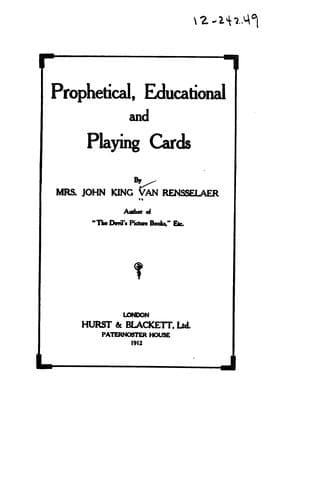
Prophetical, Educational and Playing CardsVan Rensselaer, John King, Mrs.
Religion
Prophetical, Educational and Playing Cards
Van Rensselaer, John King, Mrs.
Fortune-telling by cards -- History; Playing cards -- History
Mawe is described in Mr. Singer's "History of Playing Cards" (page 258)
"as a playe at cards grown out of the country from the meanest into credit
at court with the greatest." The game is frequently referred to by name in
books or plays written about 1580. The Ace of Hearts is called Rumstitch
or Romstecq, the name given to Mawe in the Netherlands. In Germany the
game is played with a Piquet pack of thirty-six cards, and any number of
persons from two to six may form the party. The Italians call a similar
game Romfa.
Noddy is a childish game, but it was fashionable in the seventeenth
century, and is frequently referred to by writers of that time.
Gleek is described in Cotton's "Complete Gamester," where it is called "a
noble and delightful game or recreation." It is also mentioned by Villon,
who wrote in 1461, and other contemporary authors. M. le Duchat, the
editor of Rabelais, declares that the name is derived from the German word
_Glück_, meaning chance or luck. It is played by three persons only, each
of whom is dealt twelve cards, eight being left in the widow, that is
called the "stock." The Deuces and Treys are taken from the pack. If the
Four is turned up as trump, it is called "Tiddy," and each player pays
four counters to the dealer. A Mourival is a hand holding all the Kings,
Queens, Knaves, or Aces. The players bid for the stock, as is done in
Nonsuch Euchre. The eldest hand says, "I'll vie the Ruff"; the next, "I'll
see it"; the third, "I'll see it and revie it," or, "I'll not meddle with
it," which terms are closely copied in modern games. The Ruff is the
highest flush, or else four Aces. The game of Ruff seems to have succeeded
Gleek, and many games have been evolved from it, including Bridge, Poker,
and Euchre, each one of which has adopted certain rules to the exclusion
of others, in this way making such different games that few people can
trace them to the originals. To ruff is a term still used by provincials,
by which they mean to revoke.
The steps from Ruff to Bridge are called by different names, such as Trump
or Triumpo by the Italians and Spaniards. "Ruff and Honours, Alias Slam,
was once a favourite in England," says Cotton in 1680.
In 1737 Richard Seymour published some rules, in which he says: "Whist, or
the silent game, vulgarly called Whisk, is said to be very ancient among
us, and the foundation of all the English games upon the cards." Dean
Swift declares that in his time "Whisk was a favourite among the clergy."
"His pride is in Piquet," says Lord Godolphin in Pope's "Moral Essays,"
showing the position that this game occupied in England in 1733, about
three hundred years after its introduction to the English court. It is
still played at the clubs to-day, showing what a strong hold it has upon
the affections of card players, and its original rules are hardly altered,
while the cards remain practically the same as when invented by La Hire,
Etienne Chevalier, and Jacques Coeur.
Public-domain text, read in full here on John Shaqi.
Reviews
Reviews
No reviews yet
Be the first to share your thoughts on this work.
Elsewhere in the archive
Join the Discussion
Join the discussion
Sign in to leave a comment or review.
Sign InorCreate an account