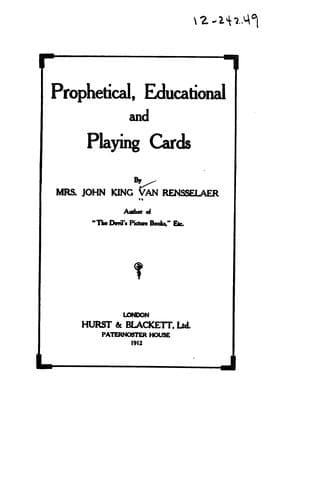
Prophetical, Educational and Playing CardsVan Rensselaer, John King, Mrs.
Religion
Prophetical, Educational and Playing Cards
Van Rensselaer, John King, Mrs.
Fortune-telling by cards -- History; Playing cards -- History
A pack of cards of 1863 represents the battle between the "Monitor" and
the "Merrimac," and the court cards are soldiers in the uniforms of the
day, such as zouaves, etc.
A pack in the British Museum displays small and very indecent pictures
with descriptive legends. Some of the latter are amusing, such as, "Hee
that has no Head wants noe Hatt." Under the picture of a bachelor maid is:
I know well how the world waggs,
He's most beloved that has most Baggs.
Under the sketch of an old woman with her pet is written: "Two heads are
better than one, which made the old woman carry her dog to Market with
her," and its mate has: "Men and Doggs may goe abroad, but Women and Catts
must stay at home." Another reads: "Two Doggs and a Bone, Two Catts and a
Mouse, Two Wives in a House can never Agree."
The picture of three doctors entering a room with their sticks to their
noses and approaching a sick man bears the legend:
If you'll avoid old Charon, the Ferryman,
Consult Dr. Dyett, Dr. Quiett, and Dr. Merryman.
The following card has on it: "An Ounce of Mirth is worth a Pound of
Sorrow."
CHAPTER XV
EUROPEAN PLAYING CARDS
According to Spanish writers, the authentic history of Playing Cards in
Europe begins about 1332, for they point with triumph to an order issued
by Alphonse of Castile, presumed to be of that date, forbidding his
soldiers to play games or to gamble. It is pointed out by disputatious
writers that the command was not directed against Playing Cards, since
they were not expressly mentioned by name, as are the other prohibited
games of chance. Then there is a second statement that Charles V of Spain,
in 1369, denounced cards, calling them by the local name of Naipes, or
prophets; and also a third record that, in 1387, dice, cards, and chess
were banned by John of Castile.
It is evident through these trustworthy records that gambling was widely
practised in Spain, and that, even if cards were not particularly named in
the first-mentioned edict, it was but little more than eighteen years
later that they had become so common it was necessary to forbid their use
through an official decree.
In 1395 the Provost of Paris issued a proclamation against Playing Cards,
showing that their abuse in the capital of France had become intolerable.
With these and other evidences, it may well be asserted that by the
beginning of the fifteenth century Playing Cards were commonly known in
the capitals of Europe, where they were publicly used for games and
gambling, as well as for fortune-telling.
It has already been mentioned that there are records of Playing Cards in
the "Red Book of Ulm," of 1397, and an account in Nuremburg, dated 1384,
when a monk preached against the inordinate love of gaming among his
congregation.
Public-domain text, read in full here on John Shaqi.
Reviews
Reviews
No reviews yet
Be the first to share your thoughts on this work.
Elsewhere in the archive
Join the Discussion
Join the discussion
Sign in to leave a comment or review.
Sign InorCreate an account