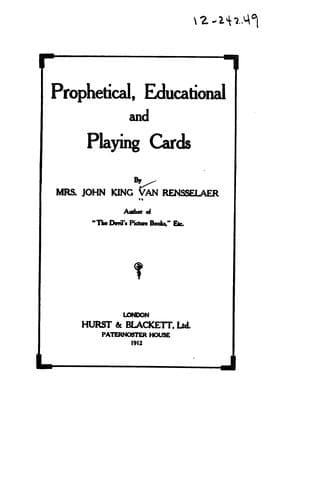
Prophetical, Educational and Playing CardsVan Rensselaer, John King, Mrs.
Religion
Prophetical, Educational and Playing Cards
Van Rensselaer, John King, Mrs.
Fortune-telling by cards -- History; Playing cards -- History
Aretino assigns the invention of cards, as well as of chess, to Palamedes,
in the Grecian camp before the wall of Troy, thus claiming a very early
date for their introduction to Europeans; but, while little credence has
been placed on this record, it is more than probable that Tarots were part
of the equipment of the camp if the soldiers wished to have their future
foretold by the messenger of the gods, and gambling sticks, made of ivory
and marked with men's heads, have been found in the tomb of King Qa, at
Abydos, Egypt.
History states that the Crusaders played at "tables" (as draughts or
checkers were then called), and also that King Richard Coeur de Lion was
fond of chess; but the English histories do not mention cards at that
date. German authors infer that cards were introduced into Europe by the
Crusaders, who, finding the Tarots common among their enemies (or
prisoners), the Saracens, learned to play from them, and as the pictures
on the cards were attractive, they used them to send home as missives to
their families, and these authors support their theory by pointing out
that cards are still called "briefe," or letters, in Germany, while we
might say that these pictures were the ancestors of the postal cards of
the present day.
Writers harp on the lack of historical data concerning Playing Cards
before the middle of the fourteenth century, oblivious of the fact that
previous to that time it is probable that Tarots would not have been
classed with games, and that educated people had not learned to use the
pack for amusement, nor had the lower classes grasped the fact that they
could be converted into a means for gambling, so they disregarded the
ancient symbols, which they considered only useful for fortune-tellers, so
cards at that date would not have been classed as gambling tools.
As soon as a game was arranged for the cards, however, they were eagerly
adopted by all classes of society as a welcome diversion. From that time
on, numerous descriptions are to be found in the archives of European
countries, appearing almost simultaneously. Gough (a writer mentioned by
the Rev. Edward Taylor in his "History of Playing Cards," page 187)
expressly states that "the Italian game called La Minchiate, which was
played with the ancient Tarot pack, was invented at Sienna by Michael
Angelo to teach children arithmetic." It would seem that the writer was
slightly confused in his ideas, for the cards invented for teaching
arithmetic were not true Tarots. He may be correct, however, in supposing
that cards were arranged by the painter for educational purposes, and that
they followed closely the number and arrangement of the older pack, for
there are such cards still to be found in collections, although hardly of
so early a date.
Public-domain text, read in full here on John Shaqi.
Reviews
Reviews
No reviews yet
Be the first to share your thoughts on this work.
Elsewhere in the archive
Join the Discussion
Join the discussion
Sign in to leave a comment or review.
Sign InorCreate an account