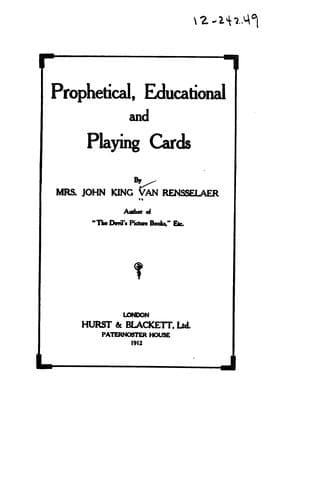
Prophetical, Educational and Playing CardsVan Rensselaer, John King, Mrs.
Religion
Prophetical, Educational and Playing Cards
Van Rensselaer, John King, Mrs.
Fortune-telling by cards -- History; Playing cards -- History
A Frenchman, Père Menestrier, studied the history of the cards that were
known to him as early as 1704, when he published "Des Principes des
Sciences et des Arts Disposé en Forme de Jeux." Others followed his
example, but they all looked upon cards simply as gambling instruments, or
regarded them as interesting historical fashion plates picturing French
celebrities, or else as rare engraved plates; so they treated the cards of
their own countries only from this point of view. Of course, most of the
writers knew only the cards of their immediate surroundings, and, if they
ever were cognizant of the ancient Tarots, disregarded them entirely.
When, in 1836, Samuel Weller Singer published his "History of Playing
Cards," he was interested in engraving, with its kindred arts, and he
found that the earliest work on wood or metal had been done to reproduce
cards. This book was followed by the "History of Playing Cards," by
William Andrew Chatto; "Origin of Playing Cards" (1865); "History of
Playing Cards," by Rev. Edward Taylor, and many others. Although two
persons in the priesthood devoted time to studying cards, they did not do
so with reference to their religious influence on their congregations.
Still, they acknowledged with surprise that these unbound leaves offered
an interesting study, and, while each one pointed out the probable
connection of Playing Cards with the Book of Thoth and the cult of
Mercury, not one of them proved the statement, but slurred it over, as if
rather ashamed of the idea, although the fact could easily have been
proved through a careful examination of the marks, the pips, and the
emblems on the cards themselves, that are so undoubtedly the heraldic
devices through which Mercury is always recognised, and which he received
from the most ancient forms of worship in Babylonia.
These authors, with other German, French, and Spanish writers, unanimously
decided that, since there is no legal record or trustworthy mention of
cards intended for use in games before the year 1392 (the one that they
seemed to agree upon, ignoring the account given of the martyrdom of St.
Cyprian in 258, who was killed for remonstrating against playing cards),
and since chance has not disclosed a hitherto unknown monument to their
birth and cradle, that these playthings were suddenly invented just about
the date when they appeared simultaneously all over Europe for the
amusement of pleasure-loving mortals. However, they quarrelled a bit as to
whether cards were first known in the Occident or in the Orient, but none
of the authors studied divination, and the rules known to astrologers,
fortune-tellers or gypsies that are carefully preserved, as well as the
evident connection of Playing Cards with the tools of the diviners of
ancient days.
Public-domain text, read in full here on John Shaqi.
Reviews
Reviews
No reviews yet
Be the first to share your thoughts on this work.
Elsewhere in the archive
Join the Discussion
Join the discussion
Sign in to leave a comment or review.
Sign InorCreate an account