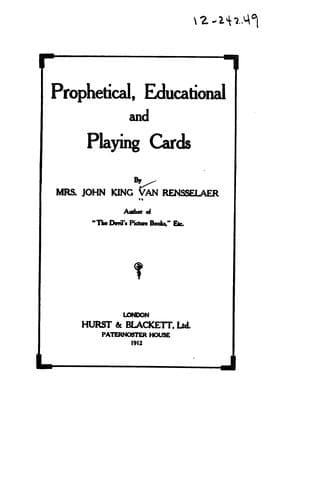
Prophetical, Educational and Playing CardsVan Rensselaer, John King, Mrs.
Religion
Prophetical, Educational and Playing Cards
Van Rensselaer, John King, Mrs.
Fortune-telling by cards -- History; Playing cards -- History
These authors proved entirely too near-sighted and would not read what the
cards themselves displayed before their semi-opened vision, probably
because they despised the professional prophets. Besides, the French,
Spanish, German, and English writers each claimed for his own country the
first knowledge of Playing Cards used for games, without recognising that
their bantlings all came from a common mother stock, the great Tarot pack.
Thus the arguments, deductions, and theories of these writers can command
respect only to a limited degree.
Merlin and Chatto have treated cards as interesting examples of the
xylographic art, and it is certainly true that they were an important
factor in developing it; but this period in the history of Playing Cards
was by no means its childhood, as the writers seem to consider. Many of
them did not know that almost every one of the European countries had
emblems peculiar to the locality, which is also the case in Asia. None of
the museums have even now any packs except those peculiar to their own
State.
In the Middle Ages games became necessary amusements in camp and home, so
there was a demand for a rapid and inexpensive form of reproduction that
should take the place of the expensively painted replicas of the Book of
Thoth, which before had been within reach only of the wealthy.
Of course, the original emblems had never been entirely lost or forgotten,
but had been concealed in the hands of the initiates, who regarded them
with reverence and transmitted them secretly from one to the other, but
did not use cards for gambling or amusement. These persons did not reveal
the history or import of the Book of Thoth to the triflers of the outside
world, and had no desire to see their treasured secrets cheaply
reproduced, to be carelessly handled by curious or pleasure-loving
people.
The author of "The Game of Gold," published at Augsburg in 1472, says he
has read that "the game of cards was introduced into Germany in 1300."
This is one of the first written accounts of Playing Cards used for games.
It was pointed out by Chatto that there is a Chinese legend claiming
Playing Cards as being used in China some two thousand years before
Christ. Doubtless the Chinese recognized that their games of divination,
as still commonly played, were identical with the cards used for chance,
as the little flat cards are still used for both purposes.
When Columbus made his first voyage across the Atlantic, his men gambled
continually, and, although the superstitious sailors threw the cards
overboard when they feared that they would never reach land, they
manufactured new ones immediately on their arrival in America, and taught
the savages their game, so we know without question that cards reached
America in 1492. They were called Naypes and bore the emblems of Swords,
Money, Cups, and Rods.
Public-domain text, read in full here on John Shaqi.
Reviews
Reviews
No reviews yet
Be the first to share your thoughts on this work.
Elsewhere in the archive
Join the Discussion
Join the discussion
Sign in to leave a comment or review.
Sign InorCreate an account