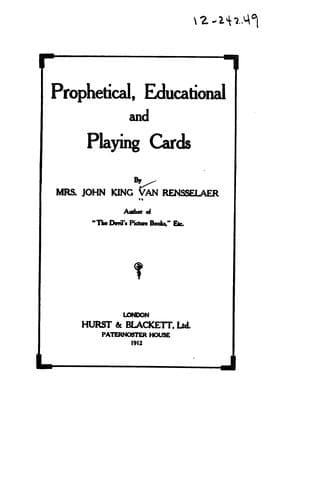
Prophetical, Educational and Playing CardsVan Rensselaer, John King, Mrs.
Religion
Prophetical, Educational and Playing Cards
Van Rensselaer, John King, Mrs.
Fortune-telling by cards -- History; Playing cards -- History
It has long been the opinion of students that the key to many things that
are mysterious to Europeans could be found through studying the habits,
customs, games, or cults of Asia and Africa, whose people cling to ancient
ideas and habits, so through looking at things with their eyes, and
listening to their views or opinions on the everyday happenings of life,
that the tangled skeins that puzzle our academically trained minds would
be unravelled.
Much has been done in this direction by Mr. F. H. Cushing and Mr. Stewart
Culin, who have discovered, by patient research in America and the Eastern
part of Asia, the value of the arrow in divination, in music, in
money-making, and in symbolism, as well as in war, for which purpose it
was primarily intended. It was put to minor uses by its simple
adaptability to the needs of the people, who were direct in their
purposes, and who used the tools that were at hand no matter for what
they were originally intended.
Any student of the Bible knows how often the gods were appealed to, not
only through the different offerings, but also for the purposes of
directly divining their wishes, which was done most frequently through a
simple stick that could be cut from any sapling. This became in turn a
"divining arrow," or a magician's wand when in the hands of the Egyptian
magi. "The staff of Moses" as used during the plagues of Egypt, or the rod
"that put forth leaves" when marked with Aaron's name. Small wonder, then,
that the "golden-leaved rod," or _Aurea virga_, given by Apollo to
Mercury, was a venerated symbol, probably derived from the Egyptians, and
by them from the Assyrians, where it was symbolically used in the worship
of the gods, and when it was placed on the cards all persons could
understand at a glance the intention and meaning of the Rod. It was not
only adopted from the Babylonians, who used it with the serpents twining
around it exactly as it is seen in Mercury's hands, but the people had
seen it put to practical use by the great marshal of the Israelites, who
confounded their wise men, or magi, with their own weapons. "And the Lord
spake unto Moses and unto Aaron, saying: ... Take thy rod and cast it
before Pharaoh, and before his servants, and it became a serpent. Then
Pharaoh also called the wise men and the sorcerers; now the magicians of
Egypt, they also did in like manner with their enchantments, for they cast
down every man his rod, and they became serpents; but Aaron's rod
swallowed up their rods." (Exodus vii:9.) Then Aaron was commanded to take
"the rod which was turned to a serpent," and to "smite the waters that
were turned into blood"; but the magicians did the same thing, and again
were able to produce the next plague by imitating Aaron's rod when it was
stretched forth. But these wise men failed with their enchantments to
produce lice at their biding, saying: "This is the finger of God." It is
more than likely that these magi were priests of the temple of Thoth, who
Public-domain text, read in full here on John Shaqi.
Reviews
Reviews
No reviews yet
Be the first to share your thoughts on this work.
Elsewhere in the archive
Join the Discussion
Join the discussion
Sign in to leave a comment or review.
Sign InorCreate an account