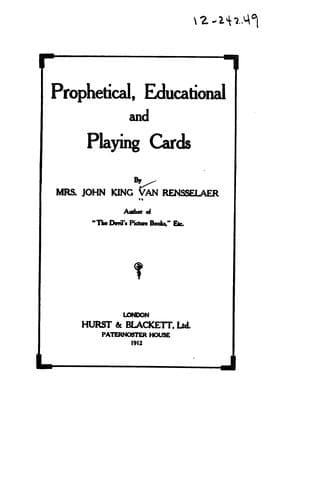
Prophetical, Educational and Playing CardsVan Rensselaer, John King, Mrs.
Religion
Prophetical, Educational and Playing Cards
Van Rensselaer, John King, Mrs.
Fortune-telling by cards -- History; Playing cards -- History
After these records of Playing Cards come some that are of later date. In
"Capitolo del Gioco della Primera," by Berni, published in Rome in 1526,
the author claims that "playing cards were invented by King Ferdinand,"
which statement may be regarded with amusement, since other Italian
records prove an earlier date.
There is an interesting invective against cards published in 1550, called
"Il Traditor," which may be translated:
What is the meaning of the female Pope,
The Chariot and the Traitor,
The Wheel, the Fool, the Star, the Sun,
The Moon, and Strength, and Death,
And Hell, and all the rest
Of these strange cards?
Showing that the Egyptian temples had not disclosed their secrets that
identified these pictures on the Tarots common in Italy with the cult of
Thoth, Mercury, and Nebo.
Painters have transmitted to us pictures of many games of cards, and
perhaps one of the earliest is the one ascribed to Van Eyck, of Philip the
Good, Duke of Burgundy, about the year 1493. The early Dutch painters
often depicted boors playing cards, and those by Jan Steen, the two
Teniers, and others are well known. Hogarth devoted a series of
engravings to depicting grotesque figures playing chess, draughts, and
cards.
After the fourteenth century, it is easy to learn the important position
that Playing Cards reached in Spain, Italy, Germany, France, and England
through the works of other painters, miniaturists, and engravers, while
books such as "Fortune-Telling," by Francisco di Milano, published in
1560, or the one by Francisco Marcolini, published in Venice in 1540,
prove the hold that the new amusement had taken on the people at that
time.
Proclamations against cards followed each other rapidly from State and
Church, so histories are filled with the denunciations of the clergy of
the fourteenth and fifteenth centuries against the old sin that had
reappeared under a new form for them to combat. Mercury was as active as
ever, and had quite as strong a hold on the affections of the people as he
had in the days when St. Paul landed in Italy, close to the Temple of
Mercury, and it was quite as hard to overcome his influence as it had been
when Christianity first began to overthrow the heathen gods. Perhaps the
day may come when those who believe in fate and predestination will
confront these preachers with the divine commands to consult the prophets
so often mentioned in the Bible, notably when the Rods of the Israelites
were marked and laid before the testimony.
CHAPTER XVI
ASIATIC PLAYING CARDS
Public-domain text, read in full here on John Shaqi.
Reviews
Reviews
No reviews yet
Be the first to share your thoughts on this work.
Elsewhere in the archive
Join the Discussion
Join the discussion
Sign in to leave a comment or review.
Sign InorCreate an account