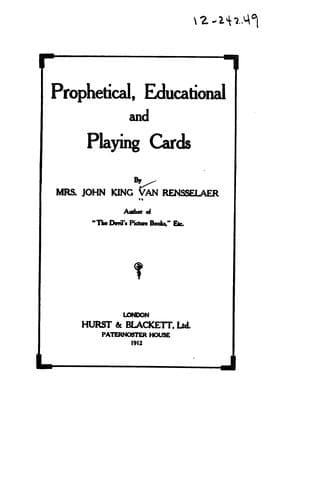
Prophetical, Educational and Playing CardsVan Rensselaer, John King, Mrs.
Religion
Prophetical, Educational and Playing Cards
Van Rensselaer, John King, Mrs.
Fortune-telling by cards -- History; Playing cards -- History
90-91-92 German Cards, showing Six of Acorns, Six of Leaves, and Six
of Hearts.
93-94 Chinese Cards showing Money and Rod emblems.]
The Alaskans also have a game somewhat like the Mora of the Egyptians and
the Italians, only it is the value of the sticks or the stripes painted on
them that must be guessed.
One step higher are the sticks used by the Hidah Indians, the natives of a
little group of islands in the Pacific Ocean off the west coast of North
America. These sticks show the totem marks of the tribes or families, such
as the Bear, the Tortoise, etc. They are clearly derived from arrows, and
sometimes have notched ends, and are still used for divination, although
also for games. Taken with those from Alaska, they are the most primitive
packs known.
The next step forward is from the wooden shafts or rods to thin slips of
yellow oiled paper, narrow and long, that belong to the Koreans. The use
of these "cards" is still the same, and the close resemblance to the
North American packs is marked, showing that all came from a common
source. These Korean cards serve as a link connecting the primitive arrow
or rod with the step that follows, from which come the Chinese gambling
tools.
The Korean cards are made of strips of paper about eight inches long by
three-quarters of an inch wide. They are uniformly decorated on the
reverse side with a feather, which Mr. Culin considers important as
attaching the cards to the original winged shaft. There are eighty cards
in the pack, divided into eight suits of ten cards each, numbered from one
to nine with numerals peculiar to these cards, which, like the device on
the other side, come from arrow feathers. The suit marks correspond to the
totemic emblems of the Koreans.
These cards are a vital bridge between the primitive traps for divination
and the more enlightened devices of the canny Egyptian priests, for it was
through the use of strips of bamboo, simple straws, or the arrows of the
period that the priests first transmitted the wishes of the gods to
mankind. But whether the cult of arrows originated in Egypt and travelled
from that centre both east and west, being modified, simplified, or
elaborated by every nation through which it passed, or whether it started
on the Pacific Ocean, to sweep across Asia to Africa and Europe, has not
been made clear.
Public-domain text, read in full here on John Shaqi.
Reviews
Reviews
No reviews yet
Be the first to share your thoughts on this work.
Elsewhere in the archive
Join the Discussion
Join the discussion
Sign in to leave a comment or review.
Sign InorCreate an account