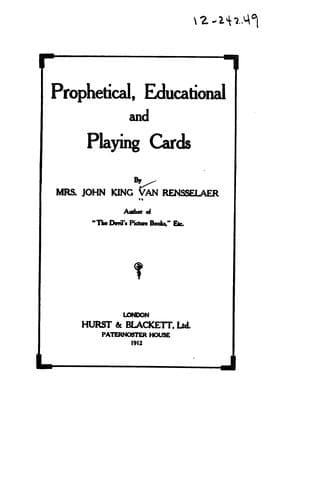
Prophetical, Educational and Playing CardsVan Rensselaer, John King, Mrs.
Religion
Prophetical, Educational and Playing Cards
Van Rensselaer, John King, Mrs.
Fortune-telling by cards -- History; Playing cards -- History
It is more than probable that the simple art of divining through the fall
of arrows is due to the primitive tribes of Asia, and certainly in Exodus,
Numbers, and others of the books of Moses, there are many records of the
direct command of the Almighty to his people to carry out his wishes
through using the "rods," or to consult his orders through occult means to
be revealed by the rods. These are authentic records on the subject, and
are supported by the tablets found at Babylonia, so we may suppose that
"the arrows of divination" spread gradually from this Asiatic centre,
becoming altered from time to time, until in many places all traces of the
original purpose was lost, and the art of consulting the wishes of the
gods through them lapsed into the pleasure of gambling.
The Korean name for their pack of cards is Htou-Tjyen, signifying
"Fighting Arrows," according to Mr. Culin in "Korean Games" (page 128).
"The suits," he says, "represent Man, Fish, Crow, Pheasant, Antelope,
Star, Rabbit, and Horse, the name of the card being written on it in
Chinese characters in some packs. Six Generals, or Court cards,
representing the heads or the chiefs of the different families, and two
entirely blank cards, or Jokers, complete the set."
Other packs have different totemic marks, but all agree with each other in
general appearance. It is said that there are a number of games that are
played with these cards, but they are difficult for a foreigner to
understand or learn.
A close connection exists between the Korean pack and the lots used by the
Chinese to divine the lucky numbers in the game called Pak-Kop-Piu, as
these cards retain the feather device, and the names of both are nearly
identical with the word for arrows.
The most common packs of Chinese cards are narrow, like those of the
Koreans, but are less than half the length, sometimes only about two and a
half inches long by a quarter of an inch wide. These packs generally have
plain red or black backs with no designs on them, and are printed with
black ink on white paper. There are at least twenty-five different kinds
of Playing Cards common in China. Some of them are intended simply for
divination, others are for gambling, and some for the amusement or
instruction of children.
Public-domain text, read in full here on John Shaqi.
Reviews
Reviews
No reviews yet
Be the first to share your thoughts on this work.
Elsewhere in the archive
Join the Discussion
Join the discussion
Sign in to leave a comment or review.
Sign InorCreate an account