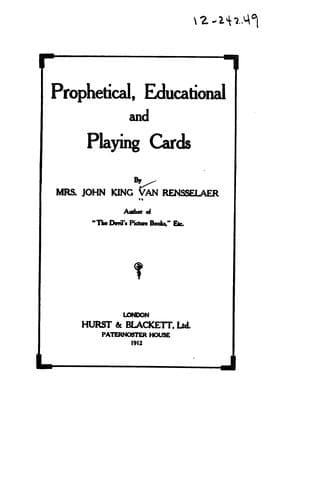
Prophetical, Educational and Playing CardsVan Rensselaer, John King, Mrs.
Religion
Prophetical, Educational and Playing Cards
Van Rensselaer, John King, Mrs.
Fortune-telling by cards -- History; Playing cards -- History
Many writers have thought that Playing Cards were simply an evolution of
Chess, and the features connecting them have been widely discussed, since
there are strongly marked attributes common to both. But, as far as is
known, Chess has never at any time been used for divination, and there are
no traditions connecting it with prophesying, while from time immemorial
cards have been used for fortune-telling by almost all nations, either
through the complete pack of Tarots, or the Book of Thoth, their
successors, the Playing Cards, or their predecessors, the divining arrows.
On the other hand, Chess is distinctly a mimic battleground, with armies
of warriors drawn in serried ranks, defying each other to mortal combat,
whether there are only two armies, as in the modern games, or four, as on
some of the Asiatic boards. The figures are the rank and file of the
army, with their castles for base and retreat, their cavalry, their
executive officers, and generals, with the monarch to preside over the
field. That in Europe one of the figures is called a Queen is strangely
out of place, for her actions and moves during the game are those of an
active lieutenant or aide-de-camp. The name has been given to the piece in
modern days, for originally and in the East it is called the Vizier. That
the piece may be called after the dame who invented the game, as is said,
seems improbable.
Some writers declare that Chess came from Southern Africa, where it is
well known; but it is also found in primitive form in Korea and throughout
Eastern Asia, and traces of it have been seen in Central Asia, where (in
Babylonia) stones have been discovered that are marked in squares, as if
intended for Draught or Chess boards.
A pretty legend is told of the Emperor Akbar, of India, for whom his
countrymen declared that the game was invented by one of his wives, who
wanted to amuse her husband, after the manner of wives, and to keep him at
home, particularly as the king was suffering from a sunstroke that made
it inadvisable for him to venture to head his army. With this end in view,
she ranged the courtiers on the black and white squares in the courtyard
within the precincts of the palace, in order that the king might amuse
himself fighting his battles in a harmless way from his divan, that was
placed in one of the balconies overhanging the enclosed space. A graphic
description of the palace is given in "Our Vice Regal Life in India," by
Lady Dufferin (page 150). Referring to the legend, she says: "There is a
curious place which is a five-storied open court, each platform getting
smaller, till the top one is a mere little summer house. Each one is
supported on rows and rows of pillars, from them one looks down into a
court, where the Great Mogul used to sit and play Chess with live pieces."
Public-domain text, read in full here on John Shaqi.
Reviews
Reviews
No reviews yet
Be the first to share your thoughts on this work.
Elsewhere in the archive
Join the Discussion
Join the discussion
Sign in to leave a comment or review.
Sign InorCreate an account