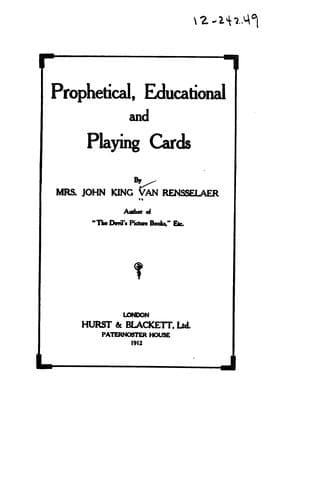
Prophetical, Educational and Playing CardsVan Rensselaer, John King, Mrs.
Religion
Prophetical, Educational and Playing Cards
Van Rensselaer, John King, Mrs.
Fortune-telling by cards -- History; Playing cards -- History
Three of these cards have black backgrounds on which is displayed a white
and yellow animal of a species unidentified. The third card of the set
shows a great dragon with a forked tail twisted around a lion. Three of
the cards have green grounds, on which are seated figures, and one of them
so closely resembles the Emperor, or Osiris, of the Tarots in position and
design that it seems it must have been derived from that figure. Of the
other two, one resembles the Atout called the Empress, and the other is a
seated male figure, in the attitude of some of those in the Tarot pack.
Four cards have black grounds sprinkled with dots of yellow. These four
all show dragons or mythical animals, and are alike in every respect,
which is not always the case with the other designs even when of kindred
suits. As none of the Atouts have animals depicted on them except in a
subordinate way, it would seem that some of the Persian cards are
original, while others may have been copied. Another green suit has only
two cards, although there might be more if the pack were complete. The
ground is _semé_, like the last, with orange-coloured flecks, and displays
a seated figure with an attendant, its peculiarity being that this King
has his legs folded under him in Oriental fashion, while the figures on
all the other cards are seated like the Egyptian gods. Two cards have gold
grounds, and on them are two standing figures, one beating a drum, the
other man holding what may be a magician's rod or, perhaps, a flute. There
are three cards of a dull yellow hue flecked with brown dots. These
closely resemble the Atouts, as one of the seated figures holds up a
circle or the Money mark, like the Queen of Dinari; and against the knees
of the other a child leans, recalling Isis with Osiris. The eighteenth
card is the Joker, and shows a likeness of the late Shah of Persia. It was
brought from that kingdom in 1904. These cards do not seem all to have
belonged to the same pack, for five of them have been much more used than
the others. The Persians are secretive about their games, probably because
the religion of Mahomet, following that of the Jews, forbids any
representation of the human form. Therefore, games bearing such an emblem
must be used in private, and descriptions of them are not readily obtained
by foreigners. The cards themselves offer an interesting problem, since
they retain the emblematic figures without any pip cards, and they stand
alone in this respect in Asia, where the pip or arrow cards are more
generally to be found than the figure cards. But, then, the Persians use
the cup or vase for divining purposes, as a rule, although in some parts
the arrows or rods of divination are common. There are also "sticks" found
among the common people that seem to be used in this way, but the natives
are chary of describing their purpose, so no trustworthy account of them
can be offered.
CHAPTER XVII
CHESS AND OTHER GAMES
Public-domain text, read in full here on John Shaqi.
Reviews
Reviews
No reviews yet
Be the first to share your thoughts on this work.
Elsewhere in the archive
Join the Discussion
Join the discussion
Sign in to leave a comment or review.
Sign InorCreate an account