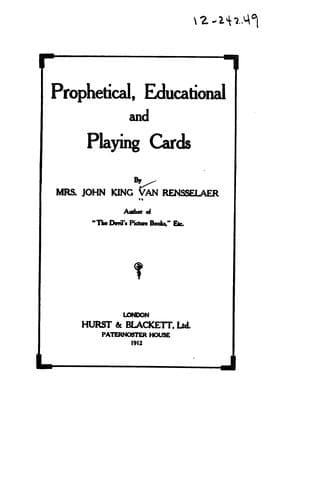
Prophetical, Educational and Playing CardsVan Rensselaer, John King, Mrs.
Religion
Prophetical, Educational and Playing Cards
Van Rensselaer, John King, Mrs.
Fortune-telling by cards -- History; Playing cards -- History
There is an Egyptian caricature of a lion and a unicorn playing a game on
a table with men, which, however, are too indistinct to describe as
chessmen. There is a set of chessmen in the British Museum, the date of
which is uncertain, that are by some considered to have been of such early
origin that they prove that the Egyptians had the game, although
deductions of this kind are sometimes overthrown by subsequent
discoveries.
That chessmen of the conventional type are by no means absolutely
necessary for a game is shown by the Korean Tjyang-Keui, whose figures
closely resemble the pieces used by the Chinese. The men of the set in the
writer's collection are of wood about the thickness of an ordinary checker
or draughtsman, but they are octagonal in shape, and the size of the
pieces varies, since it is indicative of the value. Sometimes the pieces
are circular in shape, and have their value painted in incised characters
on both sides in red, blue, or green, according to the side they
represent. The King or General is much the largest piece and about an inch
and a half in diameter. The Chariot, Elephant, Horse, and Cannon are of
medium size, while the Pawns and Councillors are the smallest. The pieces
in the writer's collection were kept by the original owner in a netted
string bag. The board differs from those of Europe, as the men are placed
at the intersections of the squares, and not in their centres, as is
customary in other places. The game, as played in Korea, is logical, and
was the inspiration of various games played in Germany, where marbles are
placed in stated positions on boards made for the purpose, with rounded
holes, and marked off with diagrams. In some games the board represents a
fort to be defended; in others, a series of positions to be captured by
one or other of two armies of equal value.
A very interesting set of chessmen in the British Museum was found at Nig,
in the Isle of Lewis, and is described as "North European, Twelfth
Century." The backs are carved with intricate interlacing designs like
those on the reverse of the old Tarots. The Queens rest their cheeks on
their right hands. The Kings have swords laid across their laps. The
Bishops are mitred, and all are seated.
Public-domain text, read in full here on John Shaqi.
Reviews
Reviews
No reviews yet
Be the first to share your thoughts on this work.
Elsewhere in the archive
Join the Discussion
Join the discussion
Sign in to leave a comment or review.
Sign InorCreate an account