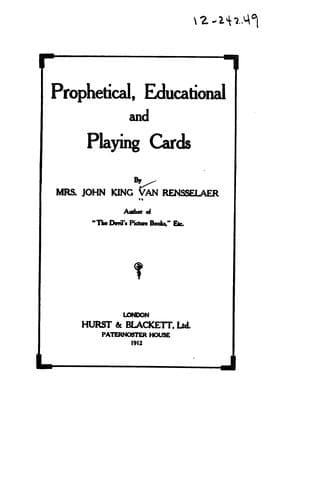
Prophetical, Educational and Playing CardsVan Rensselaer, John King, Mrs.
Religion
Prophetical, Educational and Playing Cards
Van Rensselaer, John King, Mrs.
Fortune-telling by cards -- History; Playing cards -- History
An anonymous writer declares: "The most probable conjecture is that Chess
descended from the Brahmins, through Persia, to Arabia, about the sixth
century, and passed into Europe two or three hundred years later."
Continuing, the writer says: "A mathematician named Seffa originated the
game for his master, Ravan, King of Ceylon, who was so pleased with the
device that he asked the inventor to name his own reward. The cunning sage
demanded enough wheat to cover the board, starting with a single grain for
the first square, two for the second, and so on, doubling the grains until
the sixty-four squares were covered, finally adding the whole amount
together, so when computed, it was found that more wheat would be required
than the world produced in ten years."
The Persians claim that Chess was invented in their country, pointing out
the retention of some of their names and expressions in the English game,
such as "Check," from the Persian Sciack or King, and "Mat," signifying
"dead," hence "Checkmate," or "The King is dead." These words may well
have their derivation from the Persian or Arabic, but they are not
universally employed, although Chess is of ancient origin and has been
played for centuries in Africa, Asia, and Europe. The term Rook, that is
sometimes used instead of Castle, is undoubtedly of Indian origin,
derived from Rokh, and signifying dromedary. In China this piece is called
Ku, and in Korea Tcha, words in no way connected with the Arabic.
There are many historical descriptions of Chess in Europe too well known
to be repeated; besides which, there are numerous copper, steel, and wood
engravings showing persons playing Chess.
In "A History of the Moorish Kings" (1396), there is an account of a game
played when Jussef, the heir to the throne, was ordered to be beheaded by
his usurping brother. An alcade was sent to the prison for the purpose of
carrying out the command, but, finding Jussef playing Chess, and becoming
interested in his skill, he waited until the game terminated to dispatch
the prince. However, before it was finished, the usurper, Mehemed, was
murdered, so Jussef succeeded to the throne and rewarded the kindly
executioner with money and honours.
One of the earliest descriptions of Chess in the English language was
written by Thomas Hyde in 1694, at about the time that Cotton's "Complete
Gamester," on the subject of gambling and its tools, appeared. There is a
rare book, entitled "The Game and Playes of the Chess," that, strange to
say, contains little or nothing concerning the game beyond its title.
Public-domain text, read in full here on John Shaqi.
Reviews
Reviews
No reviews yet
Be the first to share your thoughts on this work.
Elsewhere in the archive
Join the Discussion
Join the discussion
Sign in to leave a comment or review.
Sign InorCreate an account