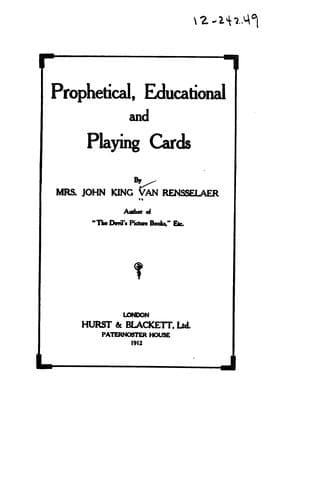
Prophetical, Educational and Playing CardsVan Rensselaer, John King, Mrs.
Religion
Prophetical, Educational and Playing Cards
Van Rensselaer, John King, Mrs.
Fortune-telling by cards -- History; Playing cards -- History
"It is remarkable," says Sir Gardiner Wilkinson, in "Ancient Egyptians"
(Vol. II, page 415), "that a game so common as Mora among the lower order
of Italians should be found to have existed in Egypt from the earliest
period of which their paintings remain, even in the reign of the First
Osirtasen." The game, which requires no accessories, is skillfully played
by holding up certain fingers to an opponent, who tries to guess the
number; it was probably carried to the Southern ports of Italy by the
Egyptians, when the yearly voyage was made to the Bay of Naples, at the
time that the great Temple of the Serapeon was erected at Pozzuoli and the
cult of Thoth Hermes introduced.
Draughts were also found in early days at or about the same place, and
that game is represented as being played on the sculptures of Beni Hassan
in grottoes on the east bank of the Nile. The same authority says: "This
would be coeval with Joseph, or 1740 B. C."
An anonymous writer in an English paper states that one of the frescoes of
the palace of Rameses II shows the mighty Pharaoh himself playing against
some of the beauties of his harem.
Many writers consider that the Roman Latronculi and the Greek
Digrammisnios were games of Chess or Draughts. A Spaniard, named Antonio
Torquemada, published rules for the latter as early as 1547, and a
Frenchman, named Pierre Malet, described the Parisian game in 1668. The
latter called for a board of sixty-four squares, the men moving but one
block at a time, and the crowned pieces having the right to move
backwards. The game was not popular in France until the days of the
Regency, when the Polish game, that is played on a board with one hundred
squares, each player having twenty pieces, became the vogue.
This variation of the old game of Draughts was introduced by a man named
Manoury, who started life as a waiter in one of the cafés. He gave lessons
to Marshal Saxe and Jean Jacques Rousseau, besides writing out the rules
governing the game for the use of his pupils.
In France and England players use the black squares on the Checker board,
but in Holland and Russia the white ones are those that are favoured, and
it is strange how puzzling this slight change is to unaccustomed players.
Public-domain text, read in full here on John Shaqi.
Reviews
Reviews
No reviews yet
Be the first to share your thoughts on this work.
Elsewhere in the archive
Join the Discussion
Join the discussion
Sign in to leave a comment or review.
Sign InorCreate an account