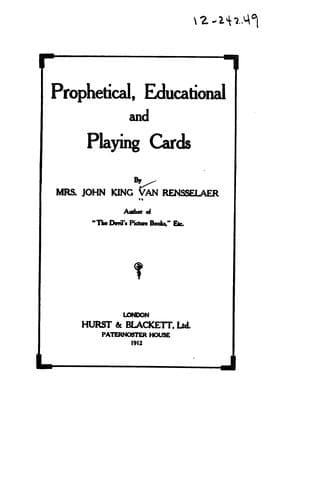
Prophetical, Educational and Playing CardsVan Rensselaer, John King, Mrs.
Religion
Prophetical, Educational and Playing Cards
Van Rensselaer, John King, Mrs.
Fortune-telling by cards -- History; Playing cards -- History
In this set there are two hooks, for separating the pieces one after
another without shaking any of the bunch. The long, slender "straws" are
four inches in length. There are eight that are carved to represent
Javelins, and eight carved like Spears. They count, respectively, one and
two marks if taken from the rest of the pile without shaking. Then there
are twenty Straws, counting ten apiece, that are delicately carved, each
one entirely different from any of the others. There is a Spade, a hooked
Spear, an Arrow, an Axe, a Flag, a Standard, a Halberd, a war Hammer, a
Javelin, a Sabre, a Lance, a Sword, a Trident, and a Pitchfork. These all
seem to be intended to represent weapons familiar in the antiquated
warfare of China. The five European implements are a long-handled Shovel,
a pair of Tongs, a Bodkin, a Pen, and a Musket. The skillful player who
captures the Tongs counts twenty, since it is twice as difficult to
disentangle as any of the other Straws, that are valued at ten marks
apiece.
CHAPTER XVIII
FORTUNE-TELLING THROUGH THE CARDS
Without in the least crediting that cards that are derived from ancient
mysteries are able to reveal the incidents connected with human life, many
people consider the trial an interesting amusement.
What were the methods used by the ancients for divining the wishes of the
gods? Truly this opens a vast field of inquiry that ranges through every
device and symbol ever invented by man.
Within a few years various plans have been suggested for reading the fate
through the hand, as is done by the Gypsies, or by the cards, as practised
by the priests of Mercury; but these are only a few hundred years old, and
probably have but little relation to the actual rites that have left no
authentic record and now can only be guessed.
Consultation of the cards serves to amuse the idle, the curious, and the
credulous, so a brief recapitulation of the two methods most in vogue may
interest readers, who can try for themselves to read what the divining
tools say through the interpretations used by two of the most celebrated
fortune-tellers of the past century, namely: Etteila and Mlle. le Normand.
The latter used modern French cards, while the former required a complete
Tarot pack that is not easy for most people to obtain.
Cardmakers have not been unready to invent for their customers various
fantastic packs with weird symbols, and to bestow on these modern
creations various significances that have no relation whatever to the old
Tarots; therefore they are valueless in the eyes of those who believe in
the ancient mysteries, which have been implicitly credited for ages, and
have a significance that is not difficult to understand, although the
different shades of meaning attributed to them by the Initiates have been
lost.
Public-domain text, read in full here on John Shaqi.
Reviews
Reviews
No reviews yet
Be the first to share your thoughts on this work.
Elsewhere in the archive
Join the Discussion
Join the discussion
Sign in to leave a comment or review.
Sign InorCreate an account