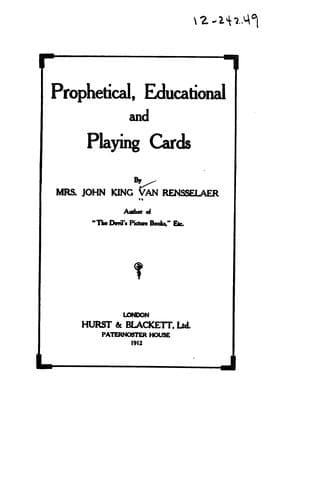
Prophetical, Educational and Playing CardsVan Rensselaer, John King, Mrs.
Religion
Prophetical, Educational and Playing Cards
Van Rensselaer, John King, Mrs.
Fortune-telling by cards -- History; Playing cards -- History
The fortune-telling packs issued by the card makers of the day generally
bear French pips, since these symbols are the ones familiar to
manufacturers in France, England, and America. They have, in addition,
badly drawn, inartistic pictures that are foolish and meaningless, since
they are neither heraldic nor symbolic, and they are only intended for
amateurs, since the true fortune-teller or Gypsy of to-day prefers the
cards with the ancient pips of Money, Swords, Rods, and Cups, together
with the Atouts.
A pack published in Frankfort-on-Main has the French, not the German,
pips, as would seem natural, and the cards are named "Le Normand Karten."
They are great favourites in Europe, where they are used for foretelling
the future and describing the past or present by credulous persons who
follow the rules laid down in the accompanying book or key, believing that
the cards were originally arranged and interpreted by the celebrated
French _cartomancie_, Mlle. le Normand herself, who had wonderful luck in
her business and has had many successors.
This pack is one and a half by three inches in width, which is smaller
than ordinary Playing Cards, and more convenient for laying out on a
table. The pack contains only thirty-six cards, with three court cards to
each suit, namely: King Queen, and Knave. The six pip cards are Ace, Six,
Seven, Eight, Nine, and Ten. Each one has a meaningless picture on it,
such as a coffin, birds, flowers, or keys, and male or female figures
dressed in the fashion of 1850. In the upper centre of each card is a
small space, on which are the court figures or the pip symbols that are
represented on an ordinary pack of French cards.
The directions for consulting the cards are printed in German and French
in a small book accompanying them, so, since any pack with French pips
would serve for the same amusement, the rules and interpretations may well
be here given, as many persons enjoy consulting the cards to discover
through them, if they may, the past, present, and future.
Shuffle and cut the cards, and then hand them to the Inquirer to cut three
times. Deal one at a time, placing them face upward on the table in rows
from left to right. The first four rows each should have eight cards, and
the fifth row only four cards, which should be placed in the middle under
the others. These signify the end of life, and the row is, consequently,
shorter than the others. The cards for this row must be put so that there
are two outside of them on either side, both left and right on the row
above them, which makes the two outside lines count only four cards from
top to bottom, while the third, fourth, fifth, and sixth lines have five
cards under them.
Public-domain text, read in full here on John Shaqi.
Reviews
Reviews
No reviews yet
Be the first to share your thoughts on this work.
Elsewhere in the archive
Join the Discussion
Join the discussion
Sign in to leave a comment or review.
Sign InorCreate an account