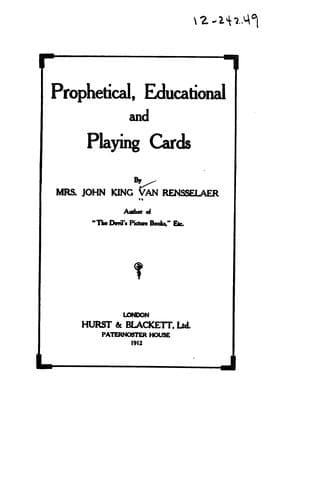
Prophetical, Educational and Playing Cards — John Shaqi
Prophetical, Educational and Playing CardsVan Rensselaer, John King, Mrs.
Religion
Prophetical, Educational and Playing Cards
Van Rensselaer, John King, Mrs.
Fortune-telling by cards -- History; Playing cards -- History
If the Tarots are the direct descendants of the occult images in the
Temple of Thoth, as is conceded, it must also be acknowledged that then
these cards each has a meaning or intention worth studying, if only to
discover their secret; and that if they are connected with the ancient
mysteries they represent human life in all its phases. To wrest their
secret from them has been the endeavor of many writers, some of whom have
learned their portent traditionally, others through careful historical
investigation, while some confess to inspiration without authority or
support, but not one of these authors discovered the important connection
between the emblems on the cards and those representing Mercury
heraldically under his chief guises, although such a discovery would have
been conclusive proof that their surmises were correct and that cards were
the survival of the cult of Mercury and his predecessors.
Nevertheless, a thorough examination of all these writers shows that
through different channels they all come to the same conclusions, and by
comparing their writings with that of the original rules for the game of
l'Ombre (or The Man) quite a definite idea of the value and meaning
attached to each card by the initiates or priests of Mercury may be
reached.
Raymond Lulle (1235-1315) gives an historical account of Tarots in his
"Ars Magna." Jerome Cardeau (1501-1576) writes of the historic pack in his
work "Subtility." An English writer named Mathers has written exhaustively
about the great book of Thoth Hermes Trismegistus, chiefly with the view
of explaining fortune-telling through a correct reading of the mysterious
leaves.
Court de Gebelin, although sneered at by the authors who followed him, who
found his learning too deep for their understanding, has given a lucid
account of Tarots and their connection with divination, while Boiteau, in
his "Les Cartes à Jouer et la Cartomancie"; Merlin, in his "Origin des
Cartes"; Chatto, in his "Facts and Speculations About Cards," and Taylor,
in his "History of Playing Cards," agree that cards appeared suddenly in
Europe early in the fourteenth century, that the cards of that day were
the Tarots, or the fortune-telling cards, that they were altered to suit
Dutch, Swedish or German tastes, or the fancies of a French king,
following also the desires of each nation that adopted them for gambling
purposes, with no thought of the ancient cult to which they had belonged.
Not one of them, however, pointed out the connecting link with the emblems
of Mercury, or explained the reason for this sudden appearance in
civilised nations of these fortune-telling packs, except De Gebelin, while
even he failed to connect the attributes of Mercury with the pips on the
cards or the emblematic figures on the Atouts that still show the
attributes of the chief gods of Egyptian mythology, that would have been
such convincing proofs of their origin.
Public-domain text, read in full here on John Shaqi.
Reviews
Reviews
No reviews yet
Be the first to share your thoughts on this work.
Join the Discussion
Join the discussion
Sign in to leave a comment or review.
Sign InorCreate an account