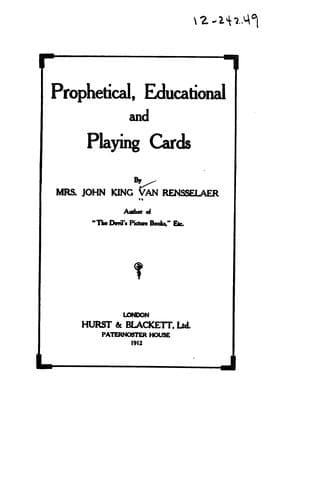
Prophetical, Educational and Playing Cards — John Shaqi
Prophetical, Educational and Playing CardsVan Rensselaer, John King, Mrs.
Religion
Prophetical, Educational and Playing Cards
Van Rensselaer, John King, Mrs.
Fortune-telling by cards -- History; Playing cards -- History
The number thirteen has always received mystic reverence, and the reason
for this has been sought by many. Among the Atouts that number is on the
card representing Death. Mercury's festival falls on the thirteenth of the
fifth month, so the thirteenth card has more than one significance to the
believers in the old pictured symbols, particularly when connected with
the Tarots.
The card known to us as the Joker combines in itself all the versatile
qualities attributed to the god Hermes himself, and it is small wonder
that it was so regarded, as he was supposed to represent in his own person
so many and such different things. Among the Atouts it is called Le Fou
(the Fool). It has no number in the pack and was not one of the pictures
that were placed on the walls, but was probably a statue occupying the
centre of the temple, where it might be separately approached. Among the
cards it outranks all others, and is as volatile and as little to be
depended upon as the god of Quicksilver himself. It controls and dominates
every card in both the pip and Atout parts of the pack. It represents the
unforeseen, the unexpected, uncertainty or uncontrollable fate, and the
destiny that presides over every walk in life. It stands for Destiny,
whether it be called Kismet, Luck, Chance, Fate or Mercury, who alone
could tell to mortals what he had foretold at their birth, when as "the
Writer" he inscribed on his "tablets" all the events of life.
Through studying the Joker and the value bestowed on him in the old as
well as in the modern packs the similarity of the powers that he wields
with those that were attributed to the Hermes of the Greeks may be
recognised, and this representation of irresponsibility, of chance or of
luck, is found in every part of the world where divining cards are used.
It marks the difference between the Tarots and the French, German and
Swiss packs that were invented for gambling only, and were never intended
for fortune-telling. That packs in the United States, with French pips,
have a Joker, does not prove that in France the gentleman is known, for he
made his appearance here after 1850, as will be related later.
The way that the Joker is represented varies most strangely. Sometimes the
card shows a group of huddled imps. Sometimes it is a blank like that of
Korea and Japan, or it may show the figure of a clown or a jester like
that of Austria. It would be interesting to follow the history of jesters
through the troubadours from Mercury himself. But each and all
representations have the same value when luck rules, and the Joker takes
every card in the pack.
CHAPTER II.
THE TAROT PACK OF CARDS
Public-domain text, read in full here on John Shaqi.
Reviews
Reviews
No reviews yet
Be the first to share your thoughts on this work.
Join the Discussion
Join the discussion
Sign in to leave a comment or review.
Sign InorCreate an account