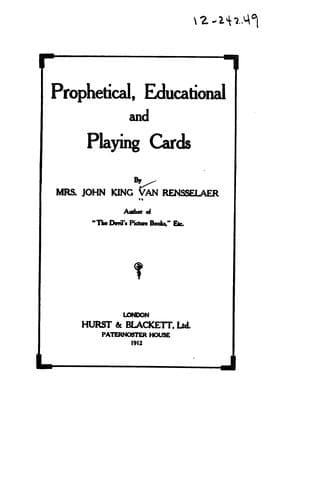
Prophetical, Educational and Playing CardsVan Rensselaer, John King, Mrs.
Religion
Prophetical, Educational and Playing Cards
Van Rensselaer, John King, Mrs.
Fortune-telling by cards -- History; Playing cards -- History
Mercury was the peacemaker, or adjuster of difficulties, as well as the
councillor and intercessor, for he could be appealed to with the certainty
that his orders could be received by mankind, and by them could be
comprehended through a sign language interpreted by his priests. He was in
reality more powerful than any of the other gods taken separately, for,
although they might be lavishly propitiated, they could not reply to
invocations except through their messenger, Mercury. He was also the
inventor of emblems, pictorial art, and language, through which he could
be directly approached and his wishes communicated in response to
invocations by means of the Atouts and the pip cards. Any profanation of
his mysteries was rapidly revenged by his worshippers, so it is little
wonder that they were not placed in town records or in early histories.
Nor, if they were, would these mysteries have been mentioned as Playing
Cards, for the ancient Book of Thoth was not classified as a game, and
until the Temple of Toth, as well as the Serapeon, near Naples, were
destroyed, compelling the exiled priests to carry on their person the
emblems taken from the walls, there was absolutely nothing like a card to
mention in the official records. Students, therefore, must search for
descriptions of wanderers, of soothsayers, of astrologers, of
fortune-tellers, of prophets or of gypsies, if they wish to discover
traces of the cult of Mercury, since it was gradually and imperceptibly
merged into the Playing Cards as we understand them.
There were few of the homes of the rich Romans that were not adorned with
a statue of this god under one of his four great attributes. The best
known is, perhaps, one by John of Bologna, showing him as Caduceator, or
the messenger, under which guise Mercury carries the caduceus and points
with his right hand to heaven. When represented in this way, he is the
bearer of news, of life, and of health. It was his wand, or caduceus,
that, up to the middle of the eighteenth century, was the emblem of the
medical man, who always carried his stick or staff into the sick
chamber. It is still used by barbers, who display his staff, apparently
wound with bloody rags, before their shops, a survival of a custom dating
from the time when barbers were the dentist surgeons and "blood-letters."
His wand was also representative of the stylus which was used to write on
the "Tablet of Fate," for Mercury was also the god Nebo of the
Babylonians, who is mentioned under this name in the Bible. He is credited
with being "the writer in the Book of Fate" and, says a Cuneiform
inscription, "had foretold the destiny of mankind since eternity." The
stylus was also the emblem of Thoth, who wrote in the "Book of Good Works"
after death.
[Illustration: ATOUTS OF AN EARLY ITALIAN PACK OF TAROTS WITH TWO COURT
CARDS
19 Il Sole
20 Il Giudizio
21 Il Mondo
22 Il Matto
23 Queen of Cups
24 King of Cups]
Public-domain text, read in full here on John Shaqi.
Reviews
Reviews
No reviews yet
Be the first to share your thoughts on this work.
Join the Discussion
Join the discussion
Sign in to leave a comment or review.
Sign InorCreate an account