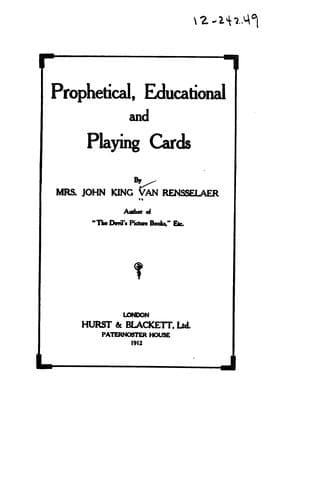
Prophetical, Educational and Playing CardsVan Rensselaer, John King, Mrs.
Religion
Prophetical, Educational and Playing Cards
Van Rensselaer, John King, Mrs.
Fortune-telling by cards -- History; Playing cards -- History
As Chthonius, Mercury was always the useful helper of mankind. He presided
at birth, when he recorded the future events of a child's life on "the
tablet of fate," as had been done by his predecessor, the god of the
Babylonians, Nebo. He also attended the dead, when the tablet was broken,
(which was Thoth's perogative), so he is allegorically represented on
funeral urns, where he is seen leading Proserpine to Hell. The vase has
been converted into one of Mercury's emblems on the cards, as the Cup or
Chalice. Many of the beautiful Etruscan vases in the Vatican show Mercury
with Pluto's reluctant wife. Perhaps the most graceful of stone pictures
on this subject is in the British Museum, where a female figure reclines
on a couch, surrounded by a group of mourners, and behind the dying woman
stands Mercury, patient and alert, ready to show the soul to its bourn.
The cup of sacrifice is overturned, the tablet is broken, and Mercury's
task is to guide her spirit carefully and gently to another sphere.
Here, then, are the four attributes of Mercury through whose aid he speaks
to men: the Caduceus, stylus or magic wand; the Coin or ring, emblem of
eternity; the Sword, and the Cup or chalice.
Always depicted as a youthful or, perhaps, irresponsible man, sometimes
described as inconsequent, volatile and light-hearted, still Mercury was
the most affording and helpful of all the gods of Olympus, and it was he
who interceded for men, who presided over births and deaths, as well as
over love affairs, business, and the arts. He was, therefore, consulted at
every turn of life--small wonder that his image was a prized ornament of
their homes, under one of his three attributes, or else near their tombs
under the fourth.
Temples to Mercury, to Thoth, and Nebo, were the principal and most ornate
ones that were built. The great one at Babylon to Nebo was called
E-Sigalia. He was worshipped as the "tablet writer" who foretold fate.
There is one to Mercury that is still in a fairly good state of
preservation and is first of the group to the other gods of Olympus, at
Baiæ, a town ten miles north of Naples in Italy. This temple was probably
erected by the rich merchants of Rome, near their own beautiful villas,
that have rendered the place historical. The other temples are little more
than charming ruins, but that of Mercury survives to remind us that
mutilated rites are still held in his honour in all parts of the world,
although by persons who have lost their clue to the original intention of
the cult that they follow.
Public-domain text, read in full here on John Shaqi.
Reviews
Reviews
No reviews yet
Be the first to share your thoughts on this work.
Join the Discussion
Join the discussion
Sign in to leave a comment or review.
Sign InorCreate an account