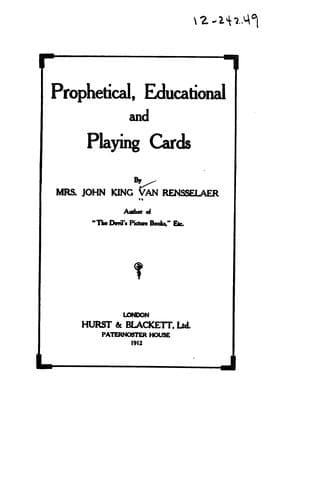
Prophetical, Educational and Playing CardsVan Rensselaer, John King, Mrs.
Religion
Prophetical, Educational and Playing Cards
Van Rensselaer, John King, Mrs.
Fortune-telling by cards -- History; Playing cards -- History
Serapis was the god of commerce, so his shrine was enriched by the
merchants who thronged to the ever-busy port. It was probably after this
temple (the original home of Mercury) was submerged, that the smaller one
was erected to him at Baiæ. The latter was a famous marine watering place
of ancient Italy, perched on an indentation of the western shore of the
Bay of Naples. It is celebrated for the softness of its climate, and the
abundance of its hot springs, so it became fashionable about the era of
Lucullus, the ruins of whose magnificent villa, as well as those of Cæsar,
Pompey and Augustus, still remain. It was a favourite resort until the
invasion of the barbarians under Theodoric the Goth.
Horace alludes to the palaces and temples overhanging the sea, but most of
these have now fallen into the water, where beautiful columns may be seen
beneath the waves.
Besides these luxurious homes, and the vast temple of Serapis that was so
near, there remain ruins of a temple to Jupiter, another to Venus, and
others that are unidentified. But the one that remains in the best
condition and state of preservation is Mercury's, as the domed roof
protected it when the others were destroyed by the ashes from the
neighbouring volcano. The façade of the temple has been removed, but one
long vaulted hall remains. It is not pierced with windows, and was
probably intended to be dark, for the better perpetration of mysteries. On
the ceiling may be traced oblong shaped paintings, "men portrayed upon the
wall," that are too much defaced to identify, but they recall the shape
and approximate size of the Atouts of the Tarots. These may be seen at
stated intervals, and, when originally placed there, would have
accommodated the twenty-two Atout cards ranged in the order in which they
are now numbered. It was supposed that the emblematic figures representing
Osiris, Maut, Isis and other deities with the virtues, vices, love,
marriage, death, etc., were placed in recesses or alcoves in the Egyptian
temples, but if these half-obliterated figures in the temple at Baiæ were
intended to represent the Atouts, a different plan was followed, more like
that mentioned in Ezekiel xxiii:14. It may have been that the priests
followed the idea of putting the figures on the ceiling, so that they
might teach their followers the significance of the emblems when it was no
longer worth while to make mysteries of them and to conceal them.
Beside the temple, and opening from it, is an inner room that was probably
once covered by a roof, but that has fallen, and now the space is only an
enclosed court. In the centre remains what might have been a platform or
altar where the sacrifices of pigs or tongues, and of other things
immolated to Mercury, were made yearly at the time of his festival, on the
thirteenth of May.
Prof. Charles Anthon, in his "Classical Dictionary," when describing
Mercury, says:
Public-domain text, read in full here on John Shaqi.
Reviews
Reviews
No reviews yet
Be the first to share your thoughts on this work.
Join the Discussion
Join the discussion
Sign in to leave a comment or review.
Sign InorCreate an account