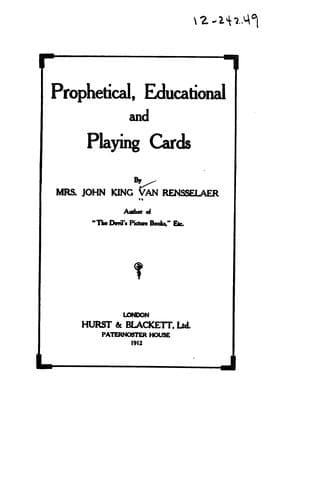
Prophetical, Educational and Playing CardsVan Rensselaer, John King, Mrs.
Religion
Prophetical, Educational and Playing Cards
Van Rensselaer, John King, Mrs.
Fortune-telling by cards -- History; Playing cards -- History
The ingenious god presented the lyre that he invented to Apollo, receiving
in exchange the "golden three-leaved rod," called by the poets _Aurea
virga_. It was represented as a wand of laurel, or olive, with two dainty
wings on one end, and entwined with two serpents, the whole emblematical
of many things besides peace, or a flag of truce, for which it was
generally used. This rod entwined with serpents is one of the most ancient
symbols and is found on a vase discovered in Babylonia that is supposed to
have been used 2350 B. C. Another device showed the staff wound with ropes
tied after a peculiar fashion, and when so depicted the caduceus
represented commerce and merchants, since the rope tied after a certain
fashion was the token of the Phoenician traders. This is retained on the
Ace of Sticks in the Tarot pack. When the caduceus was wound with stripes
of red and white it represented surgeons, or the healing arts; and, as has
been mentioned, is so displayed on barbers' poles to-day. The stick wound
in this way also represented birth, and, set before the door, was a token
of Mercury's recent visit carrying a babe from Juno to its parents. The
caduceus served Mercury as a herald's staff, and this name was sometimes
applied to the white wand or rod that in time of war was regarded as a
signal for peace.
The wings of Mercury typify the planet named for him, that is so fast that
it completes its revolution around the sun in a little less than three
months. He is connected with the old Israelitish legend, referred to in
Ezekiel ix:2, where Nebo is one of the seven planets.
The important place given to the rod in the Bible must not be overlooked.
It is closely connected with the arrow of primitive peoples, that was used
not only for war or the chase, but serving also to ascertain the wishes of
the gods, for when a bundle of arrows was cast to the ground from a quiver
or the hand, according to certain well-known laws, they indicated the
wishes of the divine power by the direction in which they fell. This is
recalled in Jeremiah, in the story of Jonathan and David, besides in many
other instances.
It was a natural sequence that Mercury, who had inherited the "tablet of
fate" from Nebo of the Babylonians, should also have received the "wand of
the magi" that, when cast before the Pharaoh by his wise men, was able to
swallow the serpents that sprang from the rod of Moses. The rod, when used
as a sceptre, has other and important significances, and is one of the
chief signs of a ruler's position and power.
Public-domain text, read in full here on John Shaqi.
Reviews
Reviews
No reviews yet
Be the first to share your thoughts on this work.
Join the Discussion
Join the discussion
Sign in to leave a comment or review.
Sign InorCreate an account