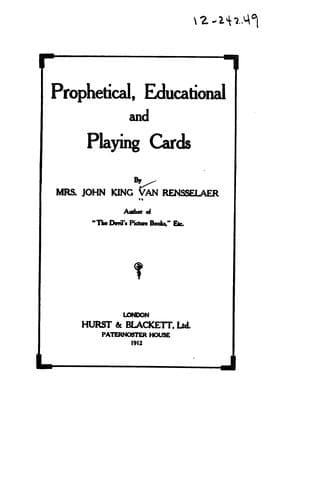
Prophetical, Educational and Playing Cards — John Shaqi
Prophetical, Educational and Playing CardsVan Rensselaer, John King, Mrs.
Religion
Prophetical, Educational and Playing Cards
Van Rensselaer, John King, Mrs.
Fortune-telling by cards -- History; Playing cards -- History
The great authority on modern Egyptian discoveries, M. Gaston Maspero,
says in his book, "Ancient Sites and Modern Scenes": "On the outskirts of
Thebes there are ruins that lie to the north of the Valley of Kings. The
temple was built or restored in the last years of the seventh, or in the
first years of the sixth, century B. C. to Thoth, the master of magic and
letters; the god who was the scribe and the magician of the gods."
This mysterious but powerful god ranked high in the Egyptian cosmogony and
the remains of his worship flourish to-day among the votaries of the card
table, who, however, no longer consult him as the oracle, but use his book
for their amusement or pleasure.
"During the Roman period, from 527 B. C. to 332 B. C., that was called the
Egyptian renaissance," says Mr. Rawlinson in his "History of Ancient
Egypt" (Volume II, page 502), "Asia poured the fetid stream of her
wonderful superstitions into Africa. The exorcisms of Thoth and the powers
of witchcraft in league with him are the favorite themes which cover the
polished surfaces of the monuments at this remarkable time." And on page
465, "Asiatic Greeks became in the reign of Psammetchas (about 610 B. C.)
close to the throne. Consequently, free communication and commercial
intercourse between Egypt and Europe were opened." This ruler was devoted
to art, architecture and adventure, and one of the inventions of his reign
was the enchorial or demotic writing which superseded the hieratic. This
was attributed to the priests of Thoth, those wise men who sought no
personal glory, but who contented themselves with placing their works at
the feet of their presiding genius and attributing their own discoveries
to him.
Without discussing whether the Assyrian god Nebo absorbed the Egyptian
Thoth, or the reverse, we may concede that such strong similarities exist
between them that they are virtually the same. With similar heraldic
symbols and functions, they were the inventors of many useful arts, that
of writing always being attributed to both. Besides, both gods were
supposed to have the power of recording the fate of mankind at birth, and
both presided at the judgment of souls after death.
The ibis-headed Thoth was also symbolized by a stylus and inkstand, and
was often termed "the Scribe," just as Nebo was called "the Writer," and
had for his device a stylus and inkstand. A month was dedicated to each,
that of Thoth being the first in the Egyptian calendar, or our September.
Its symbol was a reversed crescent with three lotus flowers, under which
were two aspects of the moon, as full and as a crescent. One cannot but
wonder if the artistic Egyptians, while adopting the cuneiform characters
which resemble long shafts with reversed triangles on top, did not alter
the lines and convert the "arrow head" of Nebo's invention into the
graceful flower, thus retaining the original conception of the symbol of
the Assyrian god, while stamping it with their own love of the beautiful.
Public-domain text, read in full here on John Shaqi.
Reviews
Reviews
No reviews yet
Be the first to share your thoughts on this work.
Join the Discussion
Join the discussion
Sign in to leave a comment or review.
Sign InorCreate an account