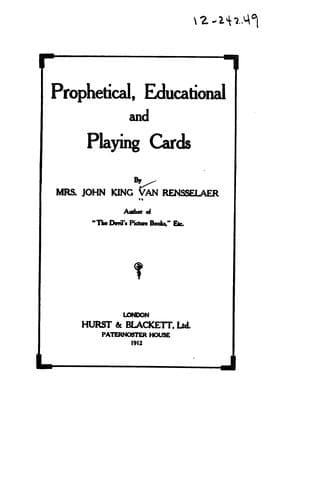
Prophetical, Educational and Playing CardsVan Rensselaer, John King, Mrs.
Religion
Prophetical, Educational and Playing Cards
Van Rensselaer, John King, Mrs.
Fortune-telling by cards -- History; Playing cards -- History
When Nebo is called "Ilu-tashmit," or god of Revelations, who teaches
through his invention of writing and of speech, he is then regarded as a
soothsayer or prophet. The Hebrew word for prophet is Nabi, and this leads
to the interesting discussion that was started by Mr. Chatto in his
"History of Playing Cards" (page 22), when he speculates on the name of
Naibi, given to cards by the earliest Italian writers who mention them. As
Naypes or Naipes is still the name printed on the wrappers and on the Four
of Cups of Spanish cards, it evidently was connected with prophesy, and
this card has peculiar values and significances among the gypsy
fortune-tellers. Mr. Chatto states that in Hindustani the word Na-eeb or
Naib signifies a viceroy or overlord, and quotes from "several Spanish
writers" who have "decidedly asserted that the word Naipes, signifying
cards, whatever it might originally have meant, was derived from the
Arabic." All the writers on playing cards quote from Corvelluzzo, who
states: "In the year 1379 was brought into Viterbo the game of cards,
which comes from the country of the Saracens and is with them called
Naib." The Arabian "divining arrows" are always made from a tree called
Nabaa.
This little history, which is one of the earliest records of cards that
were then no longer considered prophetic, has seemed to close all inquiry
into the birth of games or their vehicle. No inquiry was therefore made
into anything preceding this period. However, had cards been regarded as
the survival of one of the most ancient of cults, connected with it by its
traditions of prophesy or fortune-telling, the true story might have been
unravelled centuries ago, for a study of the traditions, religions or
superstitions of Africa and Asia would have revealed that Naibi (the name
given at that time to cards) meant prophesy or revelation, and was
inherited from the great "Writer on the Tablets of Fate," Nebo the
prophet, the Assyrian god. The prophets of the Bible were called Nabi, and
it seems to be no accident that the mountain dedicated to Nebo and
bearing his name should have been selected for the death place of the
great prophet, Moses.
Public-domain text, read in full here on John Shaqi.
Reviews
Reviews
No reviews yet
Be the first to share your thoughts on this work.
Join the Discussion
Join the discussion
Sign in to leave a comment or review.
Sign InorCreate an account