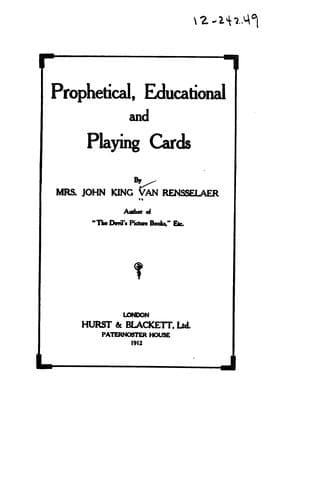
Prophetical, Educational and Playing CardsVan Rensselaer, John King, Mrs.
Religion
Prophetical, Educational and Playing Cards
Van Rensselaer, John King, Mrs.
Fortune-telling by cards -- History; Playing cards -- History
The whole of the Tarot pack has been called "the Bible of the Gypsies,"
"the Athor of the Egyptians," "the Thora of the Hebrews," "the Great Book
of Thoth Hermes Trismegistus," and "the Key of Things Hidden from the
Beginning of the World"; so, how should poor mortals be able to unravel
all its secrets and lay them bare before an uncrediting world.
CHAPTER VII
THE PIPS OF THE TAROT PACK.
The numbered or what are technically known as the pip cards of the Tarot
pack are divided like those of more modern ones into four sets, called by
English-speaking people "suits." These are headed by four court, or
"coate," cards, namely, King, Queen, Cavalier, and Knave, making one more
than usual to each suit, or fifty-six in all. Besides this royal family,
there are the cards numbered from one to ten. In some of the games two or
more of the pip cards are dropped, but this was the original pack. In
Germany there are only three court cards, like the French ones, but there
is no female in the set. The German suits are Herzen, Grünen, Eicheln, and
Schellen; the Spanish, Bastos, Otos, Coppas, and Espadas; the Italian,
Bastoni, Danari, Coppe, and Spade, and English, Rods, Money, Cups, and
Swords. These pips are emblematically displayed through appropriate
symbols, and, besides, each of them represents an idea and a number, all
of which are valuable assistants when grouping the cards, in order to
divine their hidden meanings that are almost lost to us, although quite
decipherable by those who held the key to the ancient mysteries.
The reason for invariably having four suits would be incomprehensible were
it not recognised that there were four emblems that were peculiar to and
always represented Mercury, namely, his Caduceus, his Money, his Chalice,
and his Harpé or Sword, which also typify the four grand divisions into
which the classes of people were divided all over the known world of the
day, particularly in Egypt, for they were Workmen, Merchants, Churchmen
and Soldiers, who were easily recognised through the symbols. If any man
of one of these castes wished to consult the oracle he selected the emblem
of his class and in this way communicated to the god his status in the
community.
Since four was not a favorite number among the mystics, there could have
been no other reason for selecting that number for dividing the pack into
suits, and none other has been suggested by students. As it stands, it
shows that it was arranged scientifically and with a decidedly
well-considered purpose that met all the requirements of the worshippers
at the temple of Mercury.
Public-domain text, read in full here on John Shaqi.
Reviews
Reviews
No reviews yet
Be the first to share your thoughts on this work.
Elsewhere in the archive
Join the Discussion
Join the discussion
Sign in to leave a comment or review.
Sign InorCreate an account