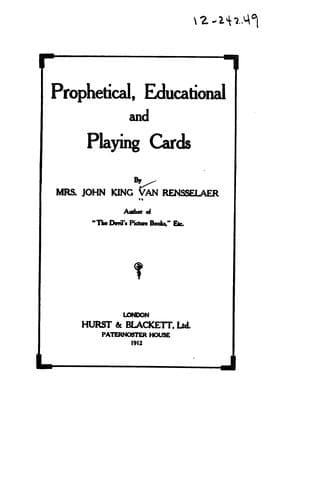
Prophetical, Educational and Playing CardsVan Rensselaer, John King, Mrs.
Religion
Prophetical, Educational and Playing Cards
Van Rensselaer, John King, Mrs.
Fortune-telling by cards -- History; Playing cards -- History
That the pips have this interpretation seems natural, for if it had been
intended to select lucky devices common at the time it is more probable
that a swatzka, a circle for immortality, or a wheel or perhaps an ankh,
that were favourites among the Egyptians would have been chosen, since all
these devices are quite as old and significant as the ones adopted, being
closely connected with mysticism, it seems to be sufficient proof that the
ones selected were taken because they represented Mercury, so these pips
must be considered valuable links in the chain connecting them with his
worship, even if they stood alone and were not supported by every card in
the Atout part of the Tarots.
That the religions, superstitions and deities of Asia, Africa and Europe
have mingled from time to time there is no doubt. E. Levi, in his "Dogme
et Ritual" (Vol. II, page 230), says: "Passing from India to Egypt with
its occultism, and then to the Hebrews and their theosophy, the stick (or
the wand) corresponds with the Phallus of the Egyptians and the Yod of the
Hebrews that is used to point to the sentence read from the Scriptures.
Thus the vase (or cup) of Mercury is the Cteis, and the primitive He, the
Sword, is the conjunction of the Phallus and the Cteis represented in
Hebrew anterior to the captivity by the Vau, while the Circle or Money
that may be vulgarly considered the emblem of the world is the final He of
the divine name. Thus we have Jod-He-Vau-He, or conventionally pronounced
Jehovah."
The wand or staff of the Tarots represents the cards as they were
originally used for divination, when a bundle of arrows, of rods, of
straws or of sticks were gathered together and cast down before the images
in the temple, so that their direction might be noted and inferences drawn
as to the wishes of the gods.
Divination arrows with many mystic significances were common among all
primitive nations. The "golden rod" given to Mercury was evidently the
magician's wand used when the plagues of Egypt were overwhelming the
land. The staff of Moses brought forth water, while that of Aaron curled
into a serpent when it symbolised eternity. There are few of the rock
pictures of Egypt that do not represent their Pharaohs, their gods, and
their priests with a sceptre, a rod, or a staff as an emblem of authority.
So it was typical in ancient days, requiring then no explanation. It may
be noticed in the Atouts that the cards representing the divinities show
each god carrying a staff or sceptre. This fact greatly aids in
identifying them, for the old Italian artists understood enough to place
the sceptre in the hand of the emperor, and give only a staff to the
hermit or priest.
Public-domain text, read in full here on John Shaqi.
Reviews
Reviews
No reviews yet
Be the first to share your thoughts on this work.
Elsewhere in the archive
Join the Discussion
Join the discussion
Sign in to leave a comment or review.
Sign InorCreate an account