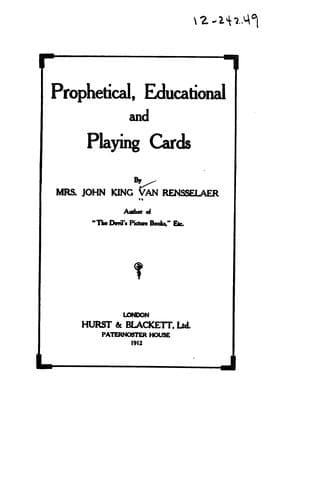
Prophetical, Educational and Playing CardsVan Rensselaer, John King, Mrs.
Religion
Prophetical, Educational and Playing Cards
Van Rensselaer, John King, Mrs.
Fortune-telling by cards -- History; Playing cards -- History
Divining arrows have been connected with worship from very early days and
probably preceded the rods. The former are mentioned more than once in the
Bible, and the first verses of Numbers xvii are particularly interesting
as being a historical reference to the divine commands to consult the
occult, as well as marking the period when rods were substitutes for
arrows. "The Lord spake unto Moses, saying, 'Speak unto the children of
Israel and take every one of them a rod according to the house of their
fathers ... twelve rods: write thou every man's name upon his rod. And
thou shalt write Aaron's name upon the rod of Levi: for one rod shall be
for the head of the house of their fathers. And thou shalt lay them up in
the tabernacle of the congregation before the testimony, where I will meet
with you.'" It was Aaron's rod that put forth leaves and fruited, showing
that he was the one selected by the Lord, who conveyed his commands in
this way.
It would be interesting to know what were the distinctive symbols of each
tribe, but the only trace of them is found in Genesis xlix, which
indicates that Judah had a lion or a sceptre. The symbol of the uplifted
hands still marks the Cohen or Aaron's descendant, while the "Magen
Dovid," or the "shield of David," the six-pointed star, has been so widely
adopted by Freemasons as to have become almost identified with them. By
some people it is called Solomon's seal.
This record of "marking" or numbering the rods is most important, for
through it we trace the origin of the marks which in the hands of the wily
Egyptian priests were afterwards placed on material they deemed more
convenient than the primitive arrows, such as papyrus, or parchment, thus
converting the divining arrows of the past into pip cards as we now know
them. Rods with notched ends, and also some on which figures of men are
cut, have been lately found in the tombs at Abydos. The divining rods of
the Alaskan Indians are given numbers by painting stripes of different
colours on them, while the rods of the Haida Island Indians, off the coast
of North America, are differentiated by tribal distinctions, such as the
Bear, the Tortoise, and so forth. The names of the different families show
how little the savage people have parted from ancient customs. The long,
thin, arrowlike paper cards of Korea show the same tribal marks.
Public-domain text, read in full here on John Shaqi.
Reviews
Reviews
No reviews yet
Be the first to share your thoughts on this work.
Elsewhere in the archive
Join the Discussion
Join the discussion
Sign in to leave a comment or review.
Sign InorCreate an account